
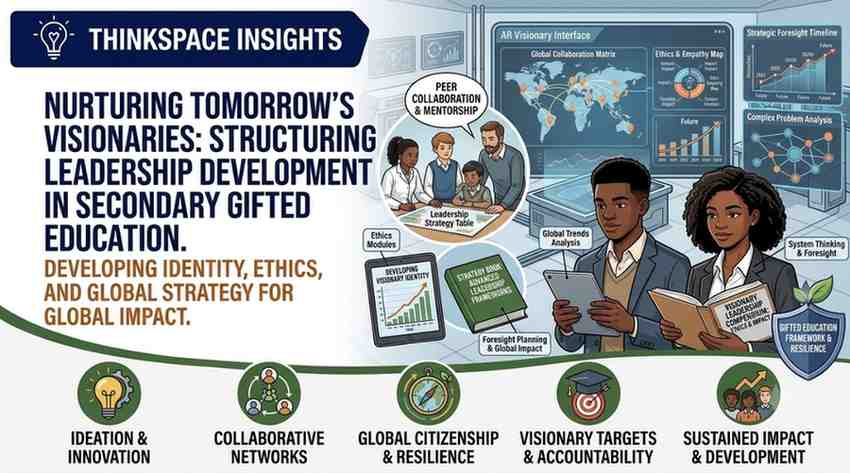
Secondary gifted education programs have long operated under the assumption that advanced learners will naturally evolve into future leaders. However, the specific pedagogical mechanics of how to intentionally foster and scale these crucial leadership skills often remain ambiguous. A compelling book chapter by researchers Catherine A. Little and Kelly L. Kearney addresses this gap by exploring leadership development as an explicit, essential element of gifted services at the secondary level.
The authors dive into the distinct challenges of differentiating leadership experiences to match the heightened cognitive capabilities of advanced learners. They evaluate the critical roles that both traditional classrooms and extracurricular activities play in honing these capabilities, while examining the ongoing academic debate surrounding the most effective settings for leadership growth—whether these skills are best cultivated within formal school structures or outside of the traditional school environment.
At its core, the chapter emphasizes the importance of providing targeted, high-level experiences that enhance fundamental execution skills, such as complex problem-solving and critical decision-making. Crucially, the text outlines the sharp distinctions between adult leadership frameworks and youth leadership development, warning educators against simply superimposing adult corporate models onto adolescent learners.
Instead, the authors argue that effective secondary programs must prioritize student voice, active decision-making agency, and authentic community engagement. Drawing on current educational research, the chapter provides secondary educators with valuable insights into creating meaningful, practical opportunities tailored to the specific needs and distinct abilities of gifted students. By reviewing existing programs and resources, the volume delivers concrete suggestions for effective implementation, ultimately emphasizing that leadership is a continuous process deeply bound to a student’s surrounding community.
ThinkSpace Insights
- Leadership development must be treated as an explicit, differentiated component of secondary gifted education rather than an assumed byproduct of high academic intelligence.
- Effective youth leadership programming must reject adult-centric frameworks in favor of adolescent-specific models that heavily prioritize student voice and personal agency.
- Maximizing leadership growth in advanced learners requires a strategic combination of formal school curricula and targeted extracurricular settings.
- Authentic leadership opportunities are built on active decision-making, helping gifted students transition from theoretical knowledge to real-world application.
- Educators must deliberately design structured experiences that target high-level cognitive skills, specifically complex problem-solving and community-based collaboration.
- Framing leadership as a continuous, community-connected process ensures that advanced students develop sustainable, socially responsible habits for the future.
Access Full Chapter