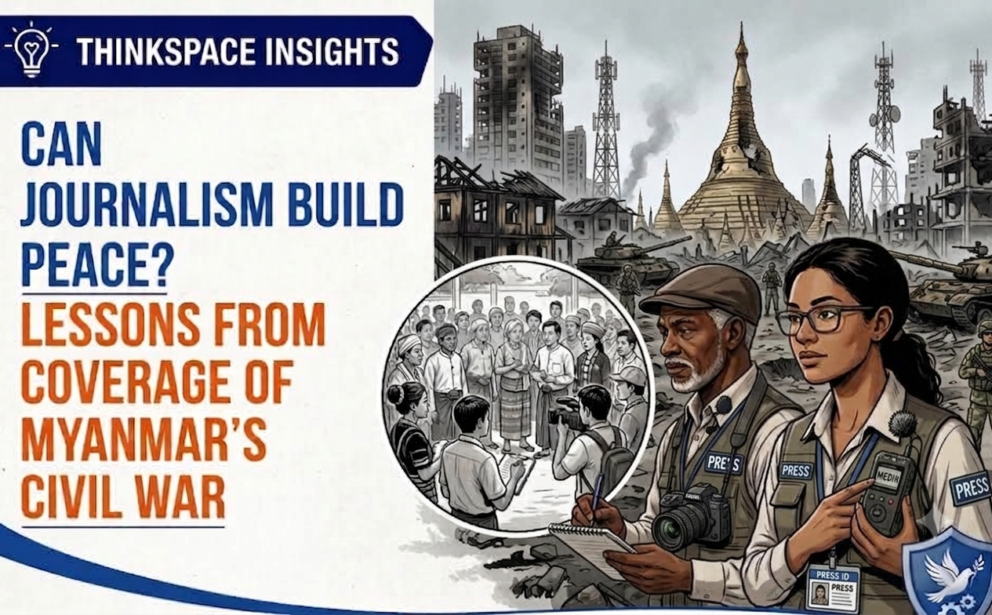
When a country descends into civil war, the conflict isn’t just fought with weapons; it is fought with information. Following the 2021 military coup in Myanmar, the nation’s political and humanitarian crises have deepened severely. In this highly polarized environment, the media does not act as a passive observer—it actively shapes how the public understands the violence and whether they see a viable path to peace. To understand this dynamic, a research team led by Ilma Waseea Adrita applied Johan Galtung’s renowned “Peace Journalism Model” to analyze exactly how two vastly different newspapers reported on the Myanmar conflict between June and December 2024.
The study evaluated 117 articles, drawing a direct comparison between the state-owned Global New Light of Myanmar (GNLM) and the internationally recognized New York Times (NYT). The results revealed two entirely separate realities. The state-run GNLM overwhelmingly utilized “war journalism” tactics, dominating 93% of its coverage. This approach relied heavily on elite-centered narratives, aggressive military vocabulary, and the complete vilification of opposing forces. By erasing contextual and humanitarian dimensions, the state media effectively acted as a mechanism to legitimize state brutality and suppress public dissent.
Conversely, The New York Times provided a radically different framework, with 97% of its reporting aligning with the principles of “peace journalism.” Instead of focusing merely on military scorekeeping and a binary “us vs. them” narrative, the international outlet emphasized the structural and historical causes of the conflict. Its coverage heavily featured the severe human suffering on the ground, highlighted various forms of civilian agency, and amplified grassroots efforts working toward a nonviolent resolution.
Ultimately, this stark contrast illustrates a critical reality about the modern information environment. Journalism possesses a profound power in conflict-affected societies where democratic discourse is severely constrained. Depending on how the narrative is framed, the media can either blindly perpetuate an endless cycle of violence or actively lay the groundwork for understanding and reconciliation.
ThinkSpace Insights
- Media is an active participant in war, heavily influencing public attitudes, enemy perception, and the overall potential for peacebuilding.
- State-owned media heavily relies on “war journalism,” with 93% of GNLM’s coverage focusing on military vocabulary, elite perspectives, and the vilification of opposition forces.
- International coverage prioritizes “peace journalism,” with 97% of NYT’s reporting emphasizing the structural causes of the conflict, human suffering, and paths to reconciliation.
- War journalism legitimizes state violence, using binary narratives to suppress dissent and ignore the humanitarian toll of the conflict.
- Peace journalism gives a voice to the marginalized, shifting the focus away from military elites and toward grassroots peace efforts and civilian agency.
Access Full Article
Https://jmsju.com/wp-content/uploads/2026/02/3-Ilma-Waseea-Adrita-et-al.pdf