
Education remains one of the most powerful tools for empowering girls and reducing long-term social and economic inequality. Yet across many parts of Nigeria, millions of girls continue to face barriers to quality education, including poverty, limited infrastructure, gender discrimination, and unequal access to technology. A recent study by Olayemi Grace Abimbola, Toyin Sidikat Adeyemi, and Esther Olabisi Kehinde explores how Information and Communication Technology (ICT) integration can improve girl-child education in Nigeria and help bridge persistent educational gaps.
The study assessed the impact of ICT integration on girls’ educational participation and academic performance, focusing primarily on Lagos State while also comparing outcomes across other Nigerian states. Using a cross-sectional survey design, the researchers collected data from 1,200 respondents, including female students, teachers, and ICT coordinators. Statistical analyses examined how ICT access, frequency of technology use, and teacher ICT competency influence educational outcomes for girls.
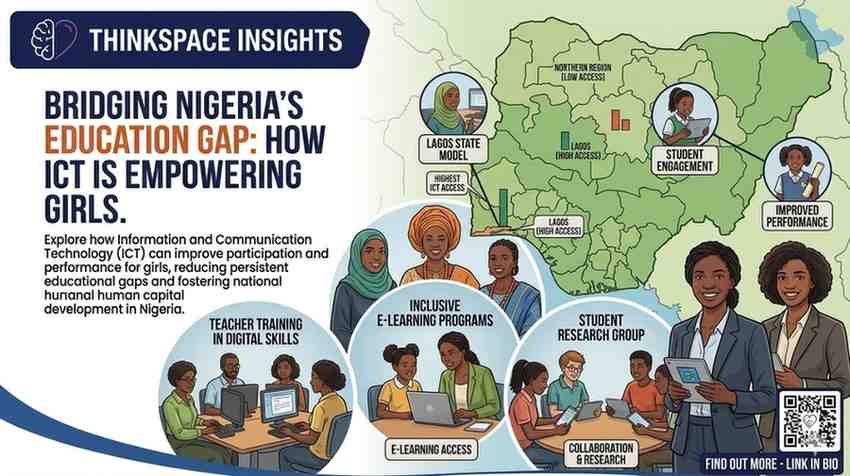
The findings reveal that Lagos State recorded the highest levels of ICT access, weekly technology use, and teacher digital competency among the regions studied. These factors were strongly associated with improved classroom participation, greater student engagement, and stronger academic performance among girls. The study suggests that access to digital tools and supportive learning environments can significantly expand educational opportunities for female students.
One of the study’s most important findings is the strong relationship between ICT access and girls’ educational participation. Regression analysis showed that improved access to technology significantly predicts higher levels of school participation among girls. The researchers argue that digital learning tools can help reduce educational barriers by providing flexible learning opportunities, broader access to information, and improved communication between students and educators.
Teacher competency also emerged as a major factor influencing educational outcomes. Schools with teachers who possess stronger ICT skills were more likely to achieve higher levels of student participation and academic performance. The findings highlight the importance of equipping educators with digital teaching skills to maximize the benefits of technology-driven education.
The study additionally found that frequent ICT use is linked to better academic performance among female students. Regular engagement with digital learning platforms, educational software, and online resources appears to strengthen learning outcomes and encourage active participation in classroom activities.
However, the research also highlights significant regional inequalities in ICT integration across Nigeria. Northern states reported lower levels of ICT access, weaker digital infrastructure, and reduced participation among girls compared to Lagos State. These disparities reflect the broader digital divide that continues to affect educational equity across the country.
The researchers argue that addressing these inequalities requires comprehensive investment in digital infrastructure, teacher training, affordable internet access, and flexible e-learning systems. Lagos State is presented as a potential model for scalable ICT integration strategies capable of reducing gender gaps in education and supporting national human capital development.
ThinkSpace Insights
1. Expand ICT Infrastructure in Underserved Communities
Governments should prioritize internet connectivity, electricity access, and digital learning infrastructure in underserved and rural areas to reduce educational inequality.
2. Strengthen Digital Skills Training for Teachers
Teacher training programs should focus on improving ICT competency to support effective digital learning and classroom engagement.
3. Increase Girls’ Access to Digital Learning Opportunities
Educational policies should ensure that girls have equitable access to computers, digital devices, online learning platforms, and technology-based educational resources.
4. Develop Flexible and Inclusive E-Learning Systems
Schools and policymakers should expand flexible digital education programs that support girls facing economic, social, or geographic barriers to traditional learning.
5. Address the Digital Divide Across Nigerian Regions
Targeted interventions are needed to close regional disparities in ICT access and ensure that girls across all states benefit equally from digital education initiatives.
The study ultimately reinforces the transformative role technology can play in advancing girl-child education in Nigeria. As digital learning becomes increasingly central to global education systems, unequal access to ICT may deepen existing educational and gender inequalities if left unaddressed.
The findings suggest that strategic investment in ICT infrastructure, teacher development, and inclusive digital education policies could significantly improve educational participation, academic outcomes, and long-term opportunities for girls across Nigeria.
Read Abstract via https://journals.fugusau.edu.ng/index.php/fufej/article/view/487?