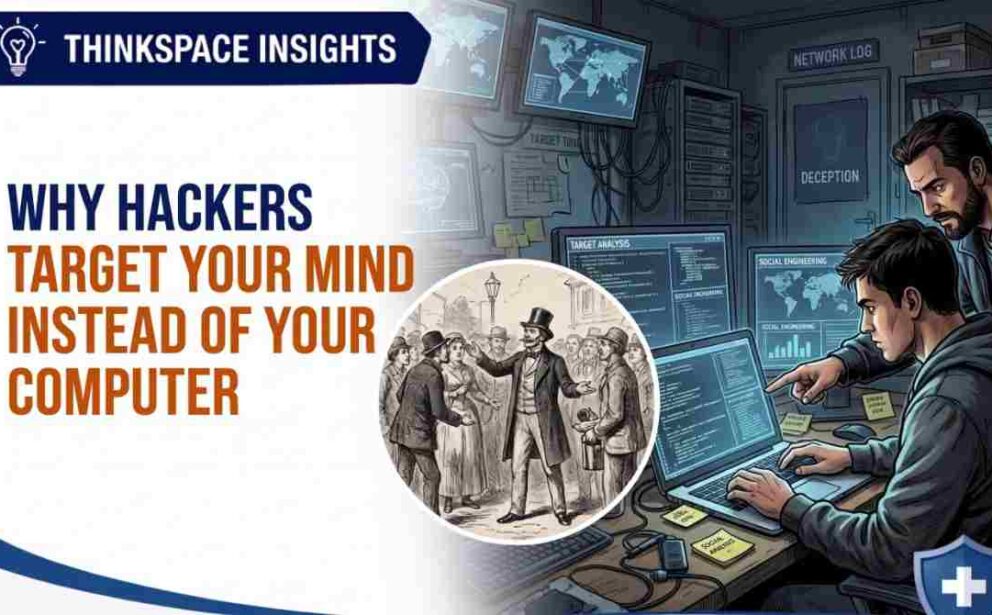
If you install a state-of-the-art home security system with reinforced steel doors, motion sensors, and 24-hour surveillance cameras, your house is technically impenetrable. However, if a burglar knocks on the front door dressed in a familiar delivery uniform and you willingly hand over the keys, that million-dollar security system instantly becomes useless. This is exactly how “phishing” operates in the digital world. Instead of trying to break through a computer’s highly advanced technical defenses, cybercriminals use deceptive emails to trick the human sitting behind the keyboard into willingly handing over passwords or credit card data. When individuals take dangerous shortcuts—such as quickly clicking an unverified link because they are rushed by a fake deadline—experts call these “shadow security behaviors”. To figure out why people make these dangerous mistakes, researchers are now using the “Health Belief Model,” a psychological framework originally designed by doctors to predict whether a patient will follow medical advice, to predict whether a computer user will follow cybersecurity protocols.
In today’s technology-dependent landscape, cyber threats pose significant risks, with phishing attacks standing out due to their sheer prominence and severity. While hardware manufacturers and application programmers constantly strive to embed better security features into their products, these purely technical defenses—like standard spam filters—remain drastically insufficient. This is because millions of malicious emails are sent daily, systematically evading detection by exploiting human vulnerabilities rather than software glitches. Consequently, the end-user serves as the ultimate, and often most fragile, last line of defense. To address this, organizations have historically rolled out generic cybersecurity awareness programs, but these “one-size-fits-all” approaches frequently fail because they completely overlook the complex psychological and behavioral factors that actually drive human decision-making.
To bridge this critical gap, researcher Anderson Kevin Gwenhure conducted a study in the emerging field of behavioral cybersecurity. By adapting the Health Belief Model, the research aimed to pinpoint the exact psychological factors that influence how university students respond to deceptive email attacks. The study collected self-reported data from 368 university students at Universitas Atma Jaya Yogyakarta in Indonesia, utilizing complex statistical methods like confirmatory factor analysis and covariance-based structural equation modeling to unpack their decision-making processes.
The results revealed exactly what it takes to make a user act safely. The data showed that students were significantly more likely to engage in proper security behaviors if they perceived the phishing attack as severe, recognized the clear importance of the security measures, received distinct cues to take action, and felt confident in their own ability to protect themselves (a concept known as self-efficacy). Interestingly, the study found that “perceived susceptibility”—whether or not the student actually believed they were a likely target for a cyberattack—did not have a significant relationship with their security behavior.
While the researcher notes that the study’s reliance on self-reported data means it primarily measures intended actions rather than actual observed behaviors, the findings are highly valuable. Ultimately, the research proves that treating humans like predictable machines does not work in cybersecurity; to build genuine digital resilience, institutions must replace generic training with tailored awareness programs designed to meet the specific psychological needs of their users.
ThinkSpace Insights
- Humans are the target, as phishing attacks purposefully bypass technical defenses like spam filters by using deceptive tactics to manipulate users into divulging sensitive information.
- Shortcuts cause breaches, highlighting that “shadow security behaviors”—such as clicking links under the pressure of completing tasks quickly—can instantly neutralize expensive technical controls.
- Medicine meets cybersecurity, with the study successfully adapting the Health Belief Model from healthcare contexts to predict human behavior in digital security scenarios.
- Confidence drives safety, revealing that students who felt confident in their ability to protect themselves (self-efficacy) and viewed the attacks as severe were significantly more likely to practice safe behaviors.
- Vulnerability isn’t a motivator, as the data surprisingly showed that a user’s perceived susceptibility to an attack did not significantly influence how safely they behaved online.
- Generic training fails, proving that traditional “one-size-fits-all” awareness campaigns are ineffective and must be replaced with psychologically tailored security programs.
Access Full Article