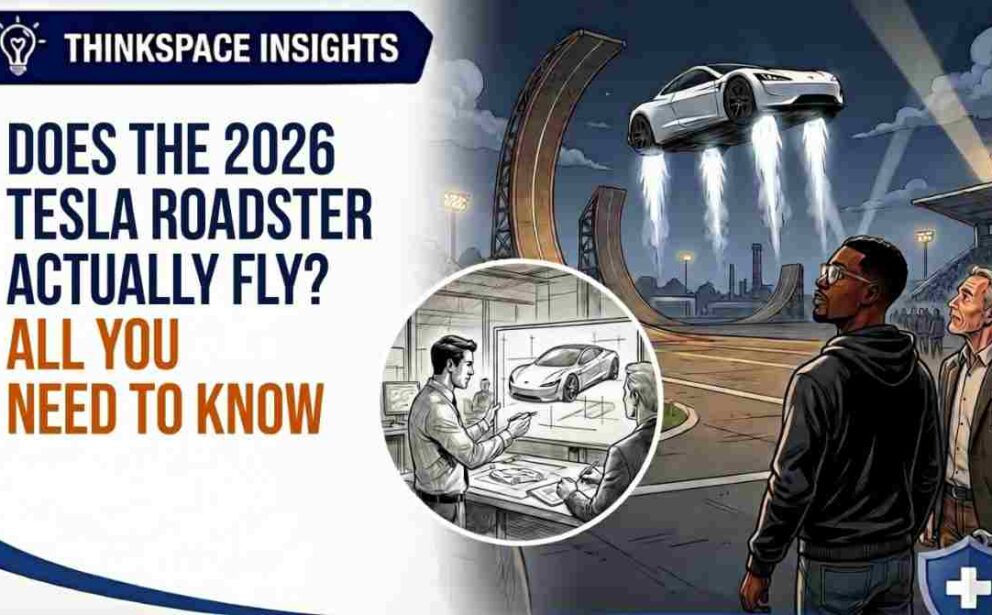
The Nine-Year Wait Is Over: Meet the Flying Tesla Roadster
It has been nine long years since Elon Musk first teased the new Tesla Roadster back in 2017. For a while, most of us thought the idea of a “flying car” was just a classic exaggeration. But at the recent October 2026 reveal at SpaceX’s Texas facility, the rules of what a vehicle can do were completely rewritten.
Before a crowd of stunned onlookers, the Roadster literally hopped off the ground and cleared a row of parked Teslas using actual cold-gas thrusters—which are basically tiny rocket engines. The wait is over, and the rumors were true. Here is everything you need to know about the most insane car Tesla has ever built.
Mind-Blowing Performance: Speed, Acceleration and Advanced Aerodynamics
Let’s get straight to the numbers, because they sound less like real life and more like something straight out of a high-octane Jason Statham movie. The new Roadster can go from 0 to 60 miles per hour in an unbelievable 0.81 seconds. To put that in perspective: by the time you finish reading this sentence, the car is already at highway speed. It also boasts a top speed of over 230 mph (about 370 km/h).
How the Tesla Roadster Sticks to the Road—even Upside Down
Why Ordinary Cars Struggle with Lift
Every car experiences two main forces at high speeds:
1. Gravity: Pulls the car down.
2. Lift: Pushes the car up. (Just like an airplane wing, the shape of a car causes air to move faster over the top than the bottom, creating upward lift.)
In a normal sports car, engineers use spoilers and splitters to reverse this lift, creating downforce to push the tires into the ground for better grip. But even with extreme downforce, if you drive a normal car into an upside-down loop, gravity will eventually win unless you are traveling at a perfectly sustained, incredibly high speed.
The Fan-Powered Suction System
Tesla engineered a unique “suction” system. Underneath the car, powerful fans literally suck the air out from under the chassis, creating a vacuum that glues the tires to the road. This grip is so intense that Elon claims the car could easily drive upside down on a special inverted ramp!
The 2026 Roadster uses an active aerodynamic system inspired by banned Formula 1 “fan cars” from the 1970s.
Instead of relying solely on the car’s forward speed to push air over a wing and create downforce, the Roadster uses powerful electric fans underneath the chassis. These fans actively suck air out from under the car and blow it out the back.
The Science Behind the Suction: How Ground Effect Works
By sucking the air out from underneath, the fans create a massive low-pressure zone (a partial vacuum) between the bottom of the car and the road. Meanwhile, the air pressure above the car remains at normal atmospheric pressure. Because high pressure always tries to move toward low pressure, the normal air above the car pushes down on the vehicle with immense force, trying to fill the vacuum underneath.
The Physics of Upside-Down Driving
This is where the “driving upside down” claim becomes a mathematical reality. For a car to drive upside down on an inverted track (like the ceiling of a tunnel), the total downforce pushing the car against the surface must be greater than the weight of the car (gravity) pulling it down to the floor.
Because the Roadster’s fans generate this vacuum artificially, it doesn’t need to be traveling at 200 mph to create that downforce. The fans can generate thousands of pounds of suction force even when the car is completely stationary. If the suction force is, say, 6,000 lbs, and the car only weighs 4,000 lbs, the car will easily stick to the ceiling—no forward momentum required.
How the Tesla Roadster Takes Flight: The Secret Behind Its SpaceX Thrusters
What Are Cold-Gas Thrusters?
If the suction system explains how the car sticks to an inverted track, how do we explain the Roadster hopping over a row of parked Teslas or flipping mid-air? It doesn’t have wings, and it isn’t using helicopter rotors or burning rocket fuel.
The secret lies in the collaboration between Tesla and SpaceX. The Roadster—specifically the high-end Rocket version—is equipped with cold-gas thrusters. These are the same type of maneuvering thrusters SpaceX uses to orient its spacecraft in a vacuum.
How Compressed Gas Generates Thrust
Here is how they make a two-ton car “fly”:
1. The Fuel: Instead of highly flammable rocket fuel, the car relies on normal, everyday air. It stores up to 600 liters (about 250 kilograms) of air inside high-strength carbon-fiber tanks.
2. The Pressure: The air inside these tanks is compressed to an incredible 10,000 PSI.
3. The Launch: When the car needs to leap or accelerate, electric actuators open valves to release this compressed air. The air shoots out of the rear thrusters faster than the speed of sound.
This sudden, violent release of compressed air creates over 80 kilonewtons of thrust. During the October 15 reveal in McGregor, Texas, this was the exact mechanism that allowed the Roadster to drive off the end of an upside-down ramp into thin air, fire its thrusters to autonomously flip upright, and land safely back on its wheels.
Is It Really Flying? Understanding Thrust-Assisted Jumps
It isn’t “flying” in the traditional sense of gliding like an airplane; it is performing highly calculated, thrust-assisted ballistic jumps.
Three Roadster Configurations: Performance, Thrust and Rocket
If you are looking to buy one, Tesla isn’t just releasing a single version of the Roadster. They are breaking it down into three distinct models, each wilder than the last:
1. The Performance Model: Everyday Road Performance
This is the “base” two-seater version. It doesn’t have rockets, but it still features active aerodynamics (parts of the car that move automatically to reduce wind resistance) to make it incredibly fast and sleek.
2. The Thrust Model: Extreme Acceleration
This is where things get crazy. For a $250,000 reservation, this version adds those SpaceX cold-gas thrusters we mentioned earlier to give you the absolute maximum acceleration while keeping the tires on the pavement.
3. The Rocket Model: The Single-Seat Flying Machine
This is an invite-only, single-seater absolute beast. It comes equipped with 10 actual SpaceX thrusters capable of lifting the car into the air. Understandably, this version is strictly for the track—you won’t be legally allowed to fly this to the grocery store.
The Autonomous Looping Track: A New Era of Automotive Stunts?
Where exactly are you supposed to drive a rocket-powered car? Tesla has a plan for that, too.
During the announcement, it was promised that a “wild looping track” will be built at the company’s Texas headquarters. Think of a giant, real-life Hot Wheels track with massive loops and ramps.
Even crazier, the car will be able to perform these extreme stunts completely on its own. Using Tesla’s autonomous (self-driving) software, the car will act almost “sentient”—meaning its artificial intelligence can calculate exactly how much rocket thrust and speed it needs to safely complete a loop-the-loop, while you just sit back and hold on for dear life.
When Will the Tesla Roadster Arrive? Production, Safety and Legal Concerns
The Production Timeline: From Promise to Reality
As amazing as all of this sounds, let’s take a step back into reality. When can you actually get one? Official production is slated for 2028. However, if you’ve followed Tesla’s history of vehicle launches—like the years of delays with the Cybertruck—it is wise to take that date with a grain of salt.
The Safety Question: How Much Acceleration Is Too Much?
Then there is the issue of safety. A car that hits 60 mph in under a second puts extreme physical force on the human body. Musk himself admitted that the Roadster is “not necessarily a safety-optimized car.”
Can You Drive or Fly It on Public Roads?
Because of the sheer speed and the literal rockets attached to the back, expect heavy regulations. It will likely face bans or strict restrictions in many cities and countries.
Conclusion: Is the Flying Tesla Roadster the Future of Driving?
Ultimately, the 2026 Tesla Roadster isn’t just a new car; it’s a bridge between everyday driving and aerospace engineering. It blurs the line between cruising down the highway and launching into orbit, standing as an absolute marvel of modern technology.
Now, I want to hear from you: Would you ever get in a car capable of pulling 0 to 60 in under a second, or has Tesla finally gone a step too far? Let me know in the comments!👇