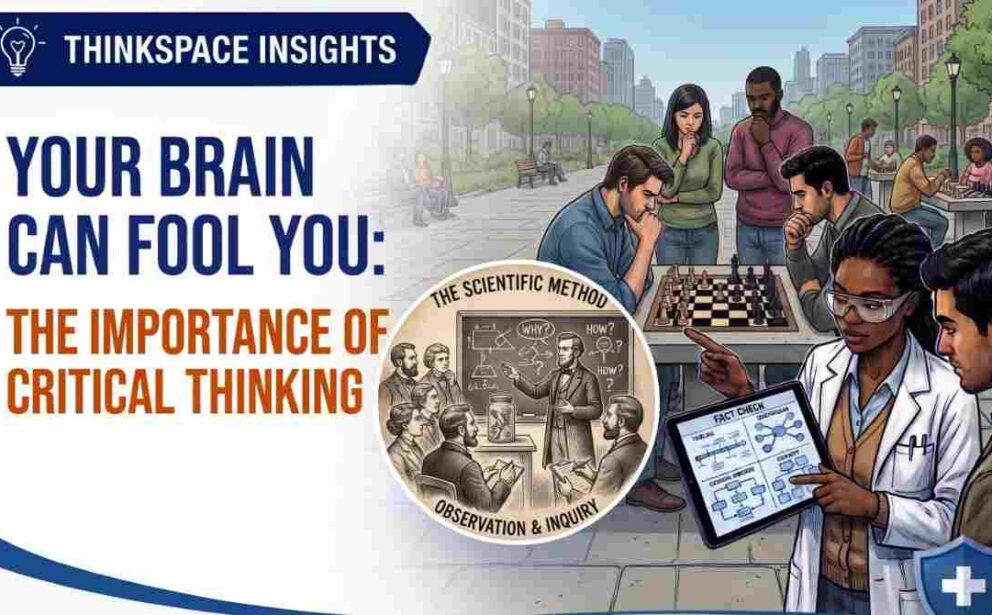
Think of the human brain like a smartphone’s auto-correct feature. If left completely unchecked, it frequently fills in the blanks with the wrong words, jumping to hasty conclusions based on past habits rather than current facts. To fix this, a user must manually take control, double-checking every word before hitting send. In cognitive science, this deliberate manual override is known as “critical thinking”. Researchers describe this process as being “self-directed, self-disciplined, self-monitored, and self-corrective”. This simply means that instead of accepting the first assumption that pops into your head, you actively force your brain to pause, analyze the data, and challenge its own underlying biases before making a final decision.
The necessity for this mental override stems from a fundamental flaw in human nature. While it is natural for everyone to think, a large portion of default human thought is naturally misinformed, incomplete, skewed, or outright prejudiced when left to its own devices. This is not merely a philosophical issue; the quality of our thoughts directly dictates the quality of our lives and the systems we build. When poor thinking drives decision-making, it carries a severe financial and societal cost, heavily impacting both economic resources and overall life quality.
To combat this default state, the concept of critical thinking has evolved into a highly structured, teachable aptitude. It goes beyond basic intelligence, requiring an individual to actively evaluate facts, arguments, and supporting data to arrive at wise conclusions. It involves identifying fundamental presumptions, contrasting various viewpoints, and determining their overall plausibility. Because this rigorous level of analysis is not an automatic or natural process, it must be deliberately induced and cultivated through strict intellectual standards.
This cognitive discipline is rapidly transitioning from a philosophical ideal to a rigid economic necessity. According to projections from the World Economic Forum (2023), analytical thinking will only become more significant in the modern workforce. The demand for reasoning and decision-making skills is expected to grow by over 70% in the next five years. Furthermore, the need for creative thinking is projected to grow even faster, increasing by almost 73% across industries.
This explosive demand creates an immediate challenge for the global labor market. To keep pace with these shifting industry needs, it is estimated that six in ten workers will require targeted cognitive training before the year 2027. Developing this human capital is no longer optional; it is a core theme for future economic stability. Workers must actively learn to take charge of the construction of their own thinking, applying methodical and accurate approaches to increasingly complex problems.
Ultimately, meeting this global demand requires a fundamental shift in how we process information. An intelligent critical thinker must maintain an open mind, constantly acknowledging and evaluating their own real-world effects and implications. By effectively collaborating with others, gathering pertinent data, and communicating precisely, these individuals can solve difficult problems and successfully navigate a highly demanding modern world.
ThinkSpace Insights
- Default thinking is flawed, as human nature left to its own devices frequently produces thoughts that are prejudiced, skewed, or misinformed.
- A deliberate override is required, showing that critical thinking demands a self-directed, self-disciplined, and self-corrective approach to actively guide belief and behavior.
- It is not an automatic trait, meaning the skill does not naturally occur and must be purposefully induced, taught, and acquired through rigorous standards.
- Massive economic demand, with the World Economic Forum predicting that the importance of analytical thinking will surge by over 70% over the next five years.
- Urgent workforce reskilling, highlighting estimates that six in ten global workers will require cognitive training before 2027 to keep pace with shifting industry needs.
- High stakes for society, noting that the caliber of human thought directly affects the quality of life, meaning poor reasoning carries a steep societal and financial cost.
Access Full Article