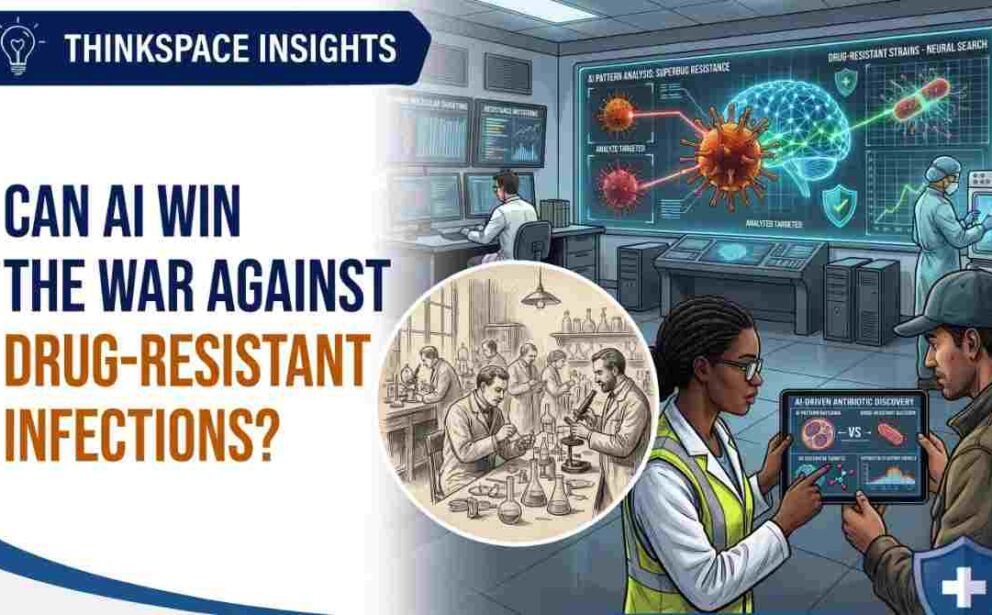
Think about the antivirus software on a computer. When hackers release a new digital virus, the security software must immediately learn its code to block it. If the software stops updating, the viruses quickly learn how to bypass the defenses, rendering the entire system useless. This is exactly what is happening in modern medicine with a crisis known as “antimicrobial resistance” (AMR). Over time, dangerous bacteria and pathogens evolve to outsmart our standard antibiotics, meaning the drugs we rely on to cure basic infections simply stop working. To combat this, doctors use “antimicrobial stewardship”—a strategy of carefully managing how and when antibiotics are prescribed to prevent bacteria from adapting too quickly. Now, scientists are bringing a massive computational upgrade to this fight, using artificial intelligence to outsmart these evolving superbugs.
Antimicrobial resistance is not just a minor medical inconvenience; it is a globally intractable problem that severely threatens to halt major advances in human health. The crisis has become so severe that the United Nations General Assembly (UNGA) recently issued a High-Level Statement defining strict global targets to mitigate the impact of resistant pathogens across human, animal, and environmental health sectors. For human health specifically, the UNGA highlighted that discovering new antibiotics, maintaining rigorous infection control, and aggressively monitoring outbreaks are all critical areas that require immediate innovation.
To achieve these ambitious global targets, researchers are increasingly turning to artificial intelligence as the ultimate defensive tool. A review by Alex Howard and a collaborative team of experts explores exactly how AI is uniquely positioned to tackle the AMR crisis. Because artificial intelligence can process massive amounts of complex information at lightning speed, it excels at revealing hidden patterns in medical data that are entirely clinically indiscernible to human doctors. This computational power allows researchers to track bacterial mutations and predict resistance trends long before human observation would detect a pattern.
This hidden data is immediately put to practical use by building advanced clinical decision support systems. These AI-driven systems assist healthcare providers by offering highly personalized care recommendations for individual patients facing stubborn infections. Beyond the hospital room, AI is also fundamentally revolutionizing the pharmaceutical pipeline. The technology is being actively applied to accelerate the complex process of drug discovery and development, helping scientists design new, effective antibiotics much faster than traditional laboratory methods. Furthermore, AI drastically improves antimicrobial stewardship and diagnostics, ensuring that existing drugs are only deployed when absolutely necessary.
On a broader scale, AI is reshaping how public health officials handle disease surveillance. By continuously monitoring global health data, AI networks can act as an early warning system, identifying localized outbreaks of resistant bacteria before they overwhelm local healthcare infrastructure. This level of widespread, automated surveillance is essential for preventing the rapid spread of untreatable infections in dense populations and achieving the overarching UNGA goals.
Despite this immense potential, deploying artificial intelligence across the global healthcare landscape is not a simple task. The researchers point out that significant barriers currently block widespread implementation, particularly regarding a lack of necessary physical infrastructure and specialized technical know-how in many regions. Additionally, the medical community must carefully navigate a minefield of complex technical, regulatory, ethical, and policy challenges to ensure these powerful AI tools are used safely and effectively. Overcoming these hurdles is absolutely essential if society hopes to stay one step ahead of the next superbug.
ThinkSpace Insights
- A global health threat, as antimicrobial resistance is an intractable problem with the potential to significantly limit major advances in human medicine.
- International targets set, with the UN General Assembly actively defining specific goals to address the impact of resistance across human, animal, and environmental health.
- Seeing the invisible, highlighting that artificial intelligence excels at revealing hidden patterns in complex clinical data that human doctors cannot discern on their own.
- Upgrading patient care, as AI-powered clinical decision support systems utilize this hidden data to provide highly personalized treatments for stubborn infections.
- Accelerating cures, noting that AI is being actively applied to speed up the discovery and development of new, effective antibiotics.
- Systemic barriers remain, cautioning that significant infrastructure deficits, alongside complex ethical, regulatory, and policy challenges, currently hinder the widespread implementation of AI in healthcare.
Access Full Article
https://www.thelancet.com/journals/laninf/article/PIIS1473-3099(25)00313-5/abstract