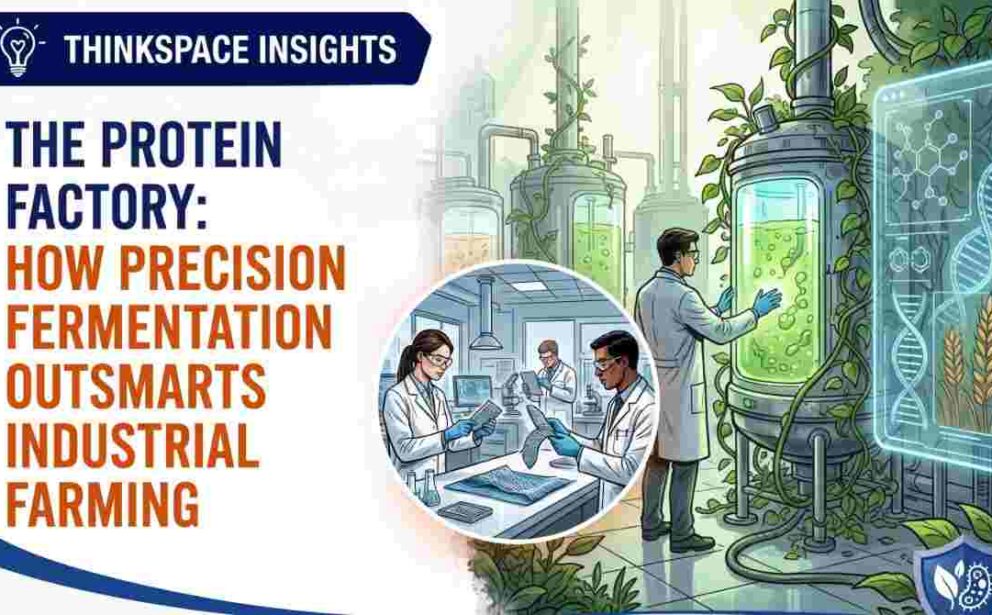
The future of sustainable food might look a lot like a modern brewery. To understand “precision fermentation,” imagine how we brew beer: we feed sugar to yeast, and the yeast produces alcohol. Precision fermentation uses this exact same concept, but with a high-tech twist. Instead of brewing alcohol, scientists program yeast or bacteria to “brew” complex molecules like the proteins found in milk, eggs, or meat. It’s a way to create real dairy or meat products without needing a single cow or chicken. The catch? Making a small batch of this animal-free protein in a laboratory is one thing. Building massive, factory-sized bioreactors that can produce enough of it to feed millions of people affordably is an engineering nightmare. That’s exactly the bottleneck this new research aims to solve.
The global food system is currently facing a critical paradox: how to feed a projected 10 billion people by 2050 while remaining within strained planetary limits. Conventional animal agriculture alone cannot meet this demand due to severe resource constraints, greenhouse gas emissions, disease risks, and geopolitical pressures. To address this, precision fermentation (PF) has emerged as a promising solution. By utilizing engineered microbial cell factories—including bacteria, yeast, and fungi—to convert simple feedstocks into alternative proteins and complex biomolecules, PF yields products identical to their natural counterparts but with a significantly lower environmental footprint.
Despite its immense potential, PF-derived proteins remain constrained by prohibitive costs, primarily driven by low volumetric productivity and suboptimal microbial yields during upstream and downstream processing. The researchers highlight that linear process expansion frequently fails because physical mixing, heat, and mass transfer limitations in massive industrial fermenters create severe environmental gradients. These gradients trigger cellular stress and metabolic redirection in the microbes, widening the gap between affordability and supply. For PF to evolve into a globally viable production platform and achieve mass-market adoption at price parity with animal-based proteins, it must move beyond empirical trial-and-error scaling.
To bridge this critical gap between scalability and affordability, the authors argue for embedding a “scalability-first” mindset early in process development. This requires an integrated upstream strategy that combines microbial host engineering, medium optimization, and scale-aware bioprocess design to maximize the titer-rate-yield. Alongside these biological optimizations, the strategic use of existing fermentation infrastructure and co-location near feedstocks is essential to lower costs and reduce logistical delays.
The review also emphasizes the critical role of early techno-economic analysis to prioritize impactful innovations, such as continuous processing and food-specific strain engineering. Furthermore, the integration of Industry 4.0 approaches—specifically AI-driven control and real-time monitoring—enables adaptive, self-optimizing processes. These digital innovations enhance robustness and improve performance at massive scales, signaling a fundamental shift from a purely biological challenge to an advanced engineering and infrastructure challenge.
ThinkSpace Insights
- A critical food paradox exists, as the global system must feed 10 billion people by 2050 without exacerbating the environmental damage caused by conventional animal agriculture.
- Precision fermentation offers a solution by programming microbes to brew alternative proteins, but broader adoption is currently blocked by the high costs of low volumetric productivity.
- Scaling up is not linear, as massive industrial fermenters introduce physical mixing and heat transfer limitations that cause cellular stress and drastically reduce microbial yields.
- A “scalability-first” mindset is required, integrating microbial host engineering with early techno-economic analysis to prioritize innovations like continuous processing before mass production begins.
- Industry 4.0 is the key to mass market viability, utilizing AI-driven control systems and real-time monitoring to create self-optimizing bioprocesses that adapt to environmental gradients at scale.
Access Full Article