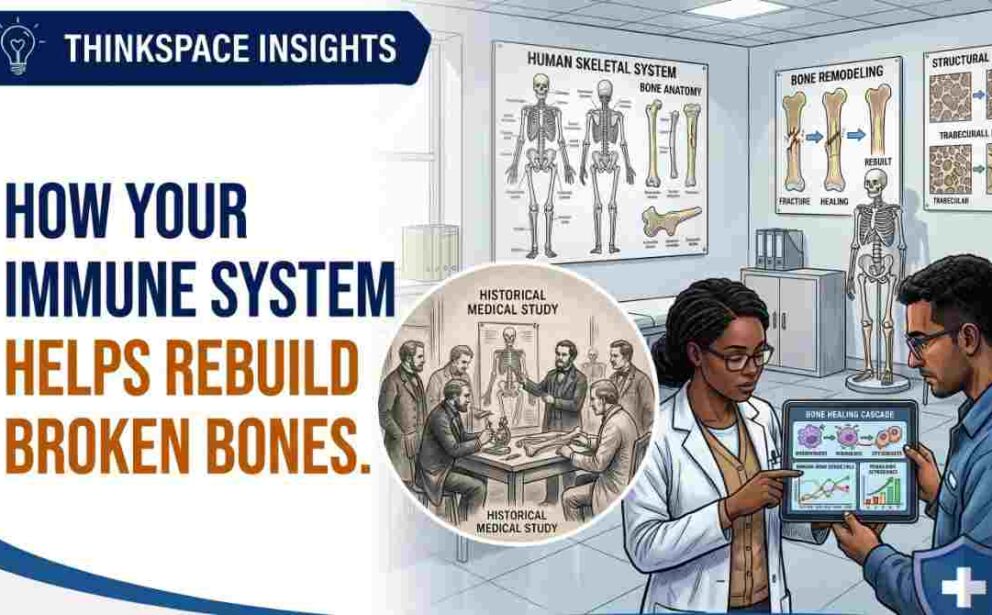
When a building collapses, the first people on the scene are not the bricklayers; they are the emergency rescue teams who clear the rubble, extinguish fires, and secure the site so the builders can eventually work safely. In the human body, when a bone breaks, an almost identical process occurs. The body’s “emergency responders”—specifically the innate immune system—rush to the fracture. They immediately deploy “macrophages,” which are specialized cells that essentially eat cellular debris, and release “cytokines,” which act as chemical distress signals to trigger acute inflammation and secure the site. Only after this microscopic wreckage is cleared and the inflammation is actively dialed back can the biological bricklayers begin constructing new bone. The study of this critical, highly coordinated interaction between immune cells and the skeletal system is known as “osteoimmunology.”
Bone fractures are a leading cause of severe physical disability worldwide. While bone possesses an incredibly high capacity for self-renewal, the healing process is not foolproof. In the United States alone, approximately 16 million fractures occur annually, imposing a massive financial and physical burden on society. Alarmingly, roughly 100,000 of these cases result in “nonunion”—a chronic condition where the bone completely fails to heal. This severe complication negatively impacts physical health and financial independence so drastically that its long-term consequences can sometimes exceed those of congestive heart failure or type 1 diabetes.
To address these severe complications and develop better regenerative therapies, a research team led by Jane Burgan comprehensively reviewed the intricate mechanisms underlying bone repair. For decades, science primarily focused on “osteoblasts” and “osteoclasts” as the sole managers of bone formation and absorption. However, Burgan’s review highlights that bone repair is vastly more complex. It relies heavily on the innate immune system, demonstrating that successful healing depends just as much on an initial burst of acute inflammation as it does on the subsequent, highly coordinated resolution of that inflammation.
During the initial acute phase, the immune system floods the fracture hematoma with neutrophils and macrophages. These cells rapidly release pro-inflammatory cytokines, phagocytose dead cells, and eliminate potential pathogens to sterilize the wound. While this fiery initial stage is absolutely necessary for tissue healing, it must be temporary. To prevent chronic inflammation and dangerous tissue scarring (fibrosis), the macrophages must undergo a process called “polarization.” They shift into an anti-inflammatory state, activating adaptive immune cells and sending crucial signals to mesenchymal stem cells (MSCs) to initiate the actual rebuilding of the bone.
While isolated fractures heal successfully about 90% of the time, the biological script flips when a patient experiences “polytrauma.” Defined by an injury severity score greater than 15, polytrauma involves multiple severe injuries across different body parts, such as combined chest trauma, abdominal injuries, and hemorrhaging. In these extreme scenarios, the patient’s immune system becomes severely weakened and highly dysregulated. This massive, uncontrolled systemic inflammatory response completely disrupts the delicate cellular crosstalk at the fracture site, causing over 30% of long bone fractures in polytrauma patients to exhibit impaired healing or nonunion.
The severe discrepancy in healing rates between isolated fractures and polytrauma cases underscores a massive gap in current medical knowledge. Burgan and her colleagues emphasize the critical need to investigate these distinct inflammatory pathways to uncover exactly why systemic trauma derails local bone repair. Moving forward, the field of osteoimmunology must focus on precision medicine—identifying predictive biomarker profiles through point-of-care diagnostic testing. By understanding how the metabolic environment guides immune properties during severe trauma, researchers can eventually develop targeted therapeutics that correct this immune dysregulation and guarantee proper fracture healing for the most severely injured patients.
ThinkSpace Insights
- The biological first responders, as the innate immune system initiates fracture healing by deploying macrophages and neutrophils to clear debris and release inflammatory cytokines.
- Inflammation must end, highlighting that successful bone regeneration requires macrophages to quickly shift into an anti-inflammatory state to prevent chronic tissue damage.
- A massive medical burden, noting that approximately 100,000 fractures annually result in nonunion, a chronic failure to heal that severely impacts long-term quality of life.
- Beyond traditional bone cells, proving that fracture repair relies heavily on complex crosstalk between immune cells and mesenchymal stem cells, rather than just standard bone-forming cells.
- Polytrauma derails repair, revealing that patients with multiple severe injuries experience a massively uncontrolled immune response, leading to impaired bone healing in over 30% of cases.
- The push for precision medicine, emphasizing the need for predictive biomarkers and point-of-care diagnostic testing to treat immune dysregulation in severely traumatized patients.
Access Full Article