
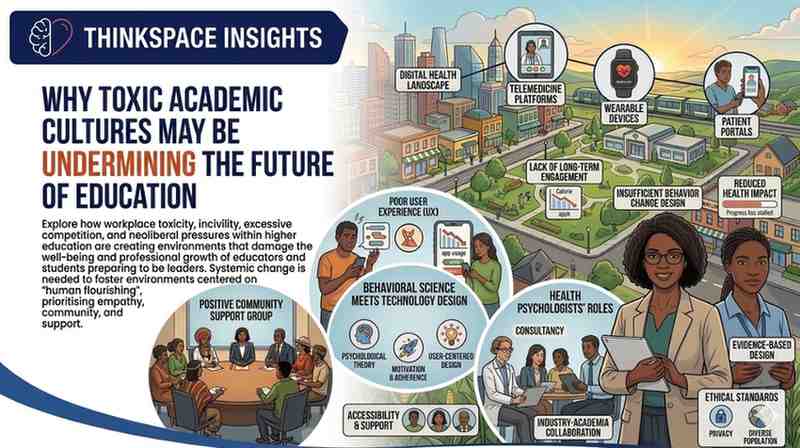
Higher education institutions are often viewed as spaces designed to foster learning, collaboration, intellectual growth, and professional development. Yet, behind the pursuit of academic excellence, many educators and students continue to experience environments shaped by incivility, excessive competition, bullying, and emotional exhaustion. A recent chapter by Lynn Bosetti, Sabre Cherkowski, Niamh Hickey, and Patricia Mannix McNamara explores how cultures of toxicity within higher education may be undermining both educator well-being and the future of teacher and leadership development.
Published in Incivility and Workplace Toxicity in P-12 Schools, the chapter argues that teacher and leadership education should be grounded not only in academic performance but also in “human flourishing” — a framework centered on positive relationships, emotional well-being, engagement, empathy, and meaningful professional growth.
The authors critique the growing normalization of incivility in academic culture, where harsh criticism, intimidation, exclusion, and bullying are sometimes disguised as intellectual rigor or professional toughness. According to the chapter, these toxic dynamics can damage self-esteem, reduce productivity, weaken collegial relationships, and create emotionally unsafe learning environments for both faculty and students.
The study further highlights how neoliberal pressures within higher education contribute to workplace toxicity. Increasing emphasis on performance metrics, competition, publication output, rankings, efficiency, and individual achievement may unintentionally encourage environments where collaboration, empathy, and community become secondary priorities.
The authors argue that this performative culture can negatively affect morale, mental well-being, and professional identity among educators and students alike. Faculty members may experience burnout, emotional isolation, and fear of professional retaliation, while students preparing to become future educators and leaders may internalize harmful workplace norms and reproduce them in schools and institutions later in their careers.
Through a detailed vignette, the chapter illustrates the emotional and psychological impact of bullying and toxic academic environments. Experiences of humiliation, exclusion, hostility, and chronic incivility can leave lasting emotional scars that affect confidence, career progression, and long-term professional development.
Importantly, the authors emphasize that addressing toxicity in higher education requires more than individual self-care strategies alone. While mindfulness, resilience training, and personal well-being practices may offer temporary support, the researchers argue that systemic and cultural transformation is necessary to create healthier educational environments.
The chapter calls for teacher educators and institutional leaders to become more reflexive about the cultures they both operate within and help create. Educational institutions, the authors suggest, should intentionally model democratic, caring, and inclusive environments that prioritize respect, empathy, collaboration, and community-building.
The researchers ultimately advocate for a “cultural rewiring” of higher education — one that aligns institutional practices with the core values of education itself. Rather than prioritizing competition and productivity above all else, universities should foster environments where individuals can thrive personally, emotionally, and professionally.
ThinkSpace Insights
1. Address Toxic Workplace Cultures Systemically
Educational institutions should move beyond individual wellness initiatives and implement structural reforms that address bullying, incivility, exclusion, and unhealthy competition.
2. Recenter Education Around Human Flourishing
Teacher and leadership education programs should prioritize empathy, emotional well-being, meaningful relationships, and collaborative learning alongside academic achievement.
3. Strengthen Psychological Safety in Academic Spaces
Universities should create environments where students and faculty feel respected, supported, and safe to express ideas without fear of humiliation or retaliation.
4. Redefine Success Beyond Performance Metrics
Institutions should balance productivity expectations with human-centered values that support collegiality, mentorship, inclusion, and sustainable professional growth.
5. Model Healthy Leadership and Democratic Educational Cultures
Future educators and leaders benefit from learning environments that actively demonstrate respect, care, inclusivity, and ethical leadership practices.
The chapter ultimately challenges higher education institutions to reconsider the cultural norms shaping academic life. While intellectual rigor and professional excellence remain important, the authors argue that education systems cannot truly succeed if they normalize environments that undermine dignity, empathy, and psychological well-being.
As concerns about burnout, workplace toxicity, mental health, and educator retention continue to grow globally, the findings suggest that reclaiming human flourishing within higher education may be essential not only for individual well-being but also for building healthier, more sustainable educational communities in the future.
Read Abstract via https://link.springer.com/chapter/10.1007/978-3-031-91555-7_5