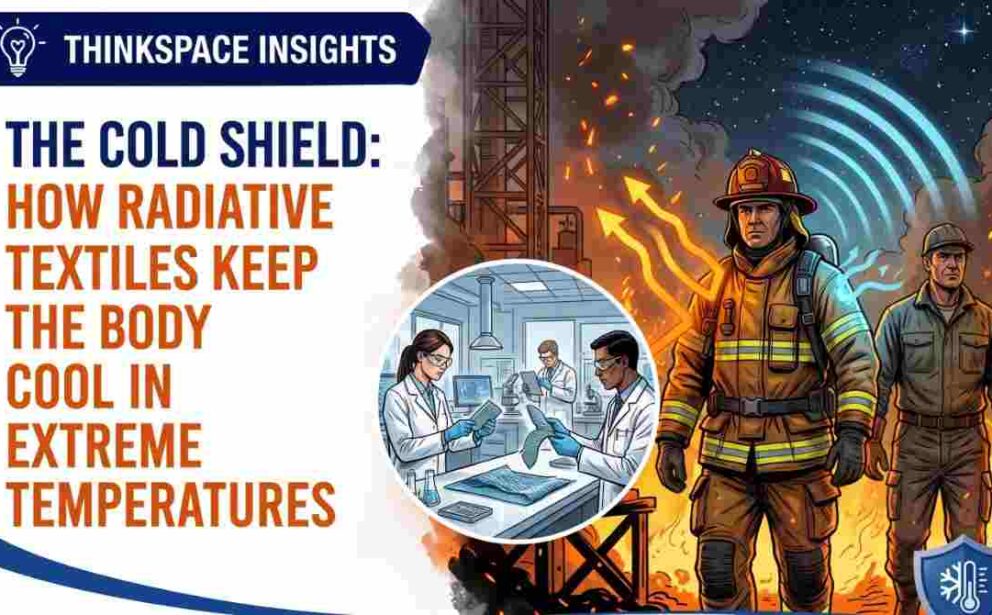
Imagine standing in the blistering summer sun, but instead of absorbing the heat, your shirt acts like a one-way mirror—bouncing the sun’s rays away while simultaneously beaming your body heat directly into outer space. This isn’t science fiction; it’s the reality of passive radiative cooling materials. Normally, to cool things down, we rely on electricity and air conditioning. But these newly engineered textiles achieve “sub-ambient” cooling—meaning they get colder than the air around them—using zero power. While researchers have proven this works in everyday conditions, a massive question remains: can these materials survive the brutal, extreme environments faced by firefighters or industrial workers without falling apart? That is exactly the engineering challenge this new research tackles.
Global warming and extreme weather patterns are increasing in frequency and severity, driving a surge in energy consumption for indoor temperature regulation. Heating, ventilation, and air conditioning (HVAC) systems currently account for approximately 38% of building energy use, underscoring the urgent need for alternative cooling strategies. Beyond indoor environments, rising global temperatures also exacerbate outdoor heat stress, posing a significant threat to public health, industry, and emergency service personnel, such as defense forces and firefighters, who frequently operate in extreme conditions.
Radiative cooling presents a promising passive thermal management solution for wearables by minimizing heat absorption and maximizing thermal emission. Since the human body dissipates 40–60% of its heat through infrared radiation within the atmospheric window (8–13 μm), materials with high infrared emissivity and low solar absorptivity are essential for effective cooling. While recent advancements have focused on developing scalable fabrics like woven meta-fabrics and nano-processed silk, significant challenges remain when translating these technologies to withstand extreme conditions. Conventional radiative cooling materials often suffer from fragility and performance degradation under mechanical stress, environmental exposure, and thermal cycling, which hinders their use in high-stress gear like firefighter suits.
To address this gap, researchers Diya Patel, Pranto Karua, Kai Zhou, and Lili Cai investigated the impact of a passive daytime radiative cooling (PDRC) coating on woven fabrics engineered for severe environments. By applying the coating to three high-performance textiles—glass fiber, carbon fiber, and Kevlar—the researchers successfully integrated superior optical, thermal, and mechanical properties. The experiments demonstrated that these coated textiles achieved exceptional solar reflectivity (93–97%) and infrared emissivity (95–96%), resulting in an average cooling of 8.3°C under direct sunlight compared to standard cotton. Furthermore, analytical modeling and experimental testing underscored the critical role of high near-infrared reflectance in high-temperature environments like fires, proving that these durable textiles are highly applicable for advanced personal protective equipment and emergency wearables.
ThinkSpace Insights
- Global warming is driving a surge in energy consumption and exacerbating outdoor heat stress, creating an urgent demand for advanced heat-resistant clothing for emergency personnel.
- Radiative cooling offers a passive solution by utilizing the 8–13 μm atmospheric window to maximize the thermal emission of body heat while minimizing solar absorption.
- Conventional radiative cooling materials are often too fragile for extreme environments, suffering from degradation under mechanical stress and thermal cycling.
- Researchers applied a PDRC coating to high-performance textiles like glass fiber, carbon fiber, and Kevlar, achieving up to 97% solar reflectivity and 96% infrared emissivity.
- These advanced coated textiles deliver an average of 8.3°C of cooling under sunlight compared to cotton while maintaining exceptional durability against environmental stressors, making them ideal for personal protective equipment.
Access Full Article