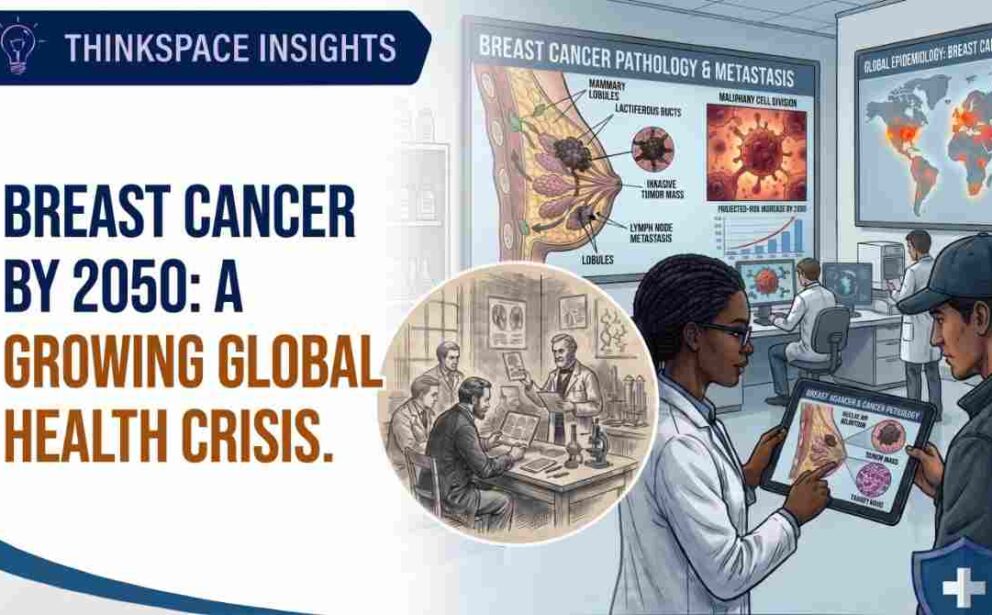
Think of a city’s healthcare infrastructure like a seawall built to hold back the ocean. If the water level steadily rises over decades but the wall is never reinforced, a catastrophic flood is inevitable. In the realm of global public health, breast cancer is a steadily rising tide. While the disease was once primarily viewed as a health crisis exclusive to highly developed, wealthy nations, the shifting demographics and lifestyles of modern society are rapidly changing the landscape. Today, the disease is surging across regions that are dangerously ill-equipped to handle it. To prevent healthcare systems in developing nations from being completely overwhelmed in the coming decades, scientists must meticulously map out exactly how and where this disease is expected to grow.
Breast cancer remains a monumental global health challenge, currently ranking as the leading cause of cancer-related mortality among females worldwide. In 2022 alone, it was diagnosed in roughly 2.3 million women, tragically resulting in 670,000 deaths. The incidence of this disease is strongly associated with a country’s Human Development Index (HDI)—a metric that combines life expectancy, education, and wealth. While the highest relative incidence rates still occur in highly developed regions like North America and Western Europe, the vast populations of less developed regions mean that over half of all new diagnoses and two-thirds of deaths now occur in low- and middle-income countries.
To understand the true magnitude of this shifting burden, a team of researchers led by Omar Freihat conducted a comprehensive analysis of global breast cancer data. The research team utilized the GLOBOCAN 2022 database, extracting comprehensive statistics on invasive breast cancer cases and deaths across 185 countries. By analyzing the Average Annual Percent Change (AAPC) between 2018 and 2022, the researchers were able to mathematically project the future global burden of the disease all the way to the year 2050.
The findings for the year 2022 reveal stark regional disparities in both incidence and survival outcomes. Asia accounted for the highest sheer volume of disease, recording an immense 985,817 cases, followed by Europe and Northern America. However, the most concerning metric is the mortality-to-incidence ratio (MIR), which measures how likely a patient is to survive a diagnosis. Africa recorded an alarmingly high MIR of 0.510, directly highlighting severe, systemic challenges regarding a lack of early detection and severely inadequate access to life-saving treatment.
When looking ahead to 2050, the projections paint a highly alarming picture of the future. The researchers estimate that global breast cancer cases will skyrocket to exceed 6 million annually. Asia is projected to experience the most significant absolute rise, reaching 2.0 million cases, closely followed by Africa, which is expected to see cases surge to over 1.1 million. Unsurprisingly, mortality is expected to rise proportionally alongside these new cases, with Asia and Africa bearing the overwhelming majority of the global death toll.
Perhaps most troubling is that the survival disparities are projected to remain deeply entrenched. By 2050, the mortality-to-incidence ratio will remain dangerously elevated in Africa (0.35) and Asia (0.25) compared to much lower rates in Europe (0.20) and Northern America (0.13). The researchers conclude that this massive projected rise in incidence and mortality demands immediate, region-specific interventions. To save lives and prevent a global health catastrophe, international public health strategies must aggressively focus on improving early detection, expanding access to modern treatment, and reducing modifiable risk factors, particularly within transitioning economies.
ThinkSpace Insights
- A global leading killer, as breast cancer remains the leading cause of cancer-related mortality among females, with 2.3 million cases and 670,000 deaths in 2022 alone.
- A shifting geographic burden, noting that while incidence is high in developed nations, over half of all cases and two-thirds of deaths now occur in low- and middle-income countries.
- Severe survival disparities, with Africa recording an alarmingly high mortality-to-incidence ratio (0.510) in 2022 due to severe challenges in early detection and treatment access.
- A massive projected surge, as researchers estimate that global breast cancer cases will skyrocket to exceed 6 million annually by the year 2050.
- Developing nations hit hardest, projecting that Asia and Africa will experience the most significant rises in both new cases and proportional mortality over the next three decades.
- Urgent interventions needed, concluding that targeted, region-specific strategies focusing on early detection and treatment access are absolutely essential to mitigate this looming crisis in transitioning economies.
Access Full Article