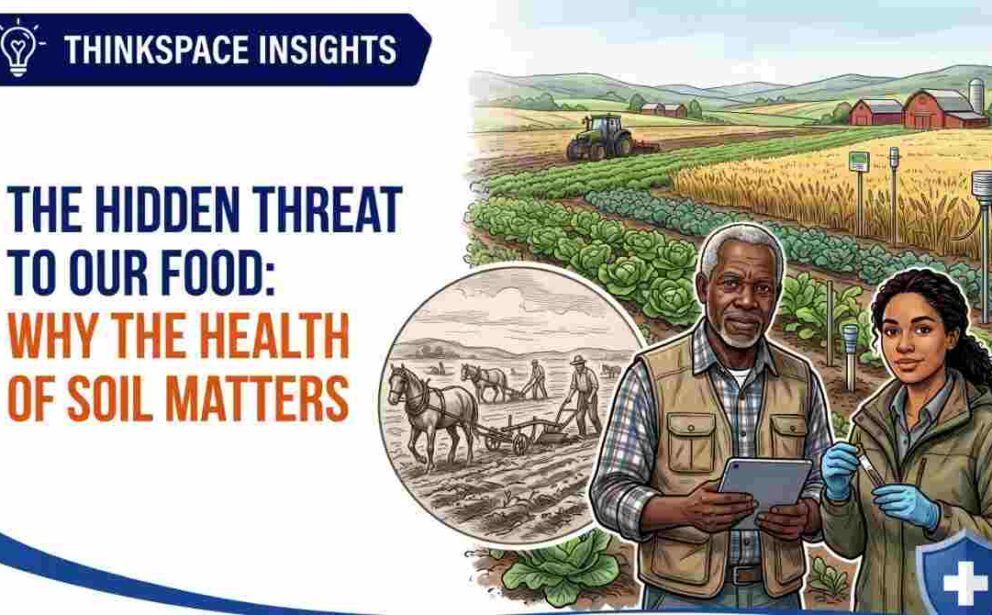
Humanity relies on soil to supply an astonishing 97% to 99% of its total caloric intake. Despite its foundational role in human survival, the unprecedented pressure currently placed on global agricultural lands is driving rapid and severe soil degradation. This structural breakdown is manifesting through widespread erosion, critical losses of soil organic matter, rapid acidification, toxic contamination, salinization, and a profound loss of biodiversity. A recent study by Peter M. Kopittke and a team of researchers explores exactly how these hidden costs of degradation are inherently decreasing global food production and threatening both food security and planetary health.
The direct impact of this agricultural deterioration on crop yields is staggering. The researchers highlight that the ongoing loss of soil organic matter alone is predicted to cause a 4.3% decrease in yields for essential staple crops, effectively erasing the calories required to feed 640 million people. Furthermore, unchecked soil erosion is projected to cause a massive 10% loss in total global crop production by the year 2050. While some forms of soil degradation lead to permanent decreases in food production, the agricultural industry frequently attempts to mask or reverse these adverse effects by aggressively increasing anthropogenic inputs, such as synthetic fertilizers and heavy irrigation.
However, relying on these artificial inputs creates a dangerous environmental feedback loop. The study demonstrates that both the initial soil degradation and the subsequent additional inputs required to artificially sustain productivity result in substantial planetary harm. Pumping degraded soil full of compensatory fertilizers actively exacerbates massive global crises, directly contributing to accelerated climate change and widespread aquatic eutrophication.
This environmental crisis is compounding an already fragile global food system. While global calorie production has historically outpaced requirements, demand continues to skyrocket due to a human population that surged from 3.1 billion in 1961 to 8 billion in 2022. Alongside population growth, the average caloric consumption per person has also jumped from 2,200 to 2,990 kcal per day over the same period, driven largely by rising wealth and shifting dietary patterns. Despite producing enough food globally, the system remains deeply inequitable; an estimated 713 to 757 million people experienced hunger in 2023, and global food demand is still expected to surge by 35% to 56% between 2010 and 2050. Addressing this complex crisis requires urgent action to develop integrated policy frameworks that protect both the stability of our food supply and the long-term health of the planet.
ThinkSpace Insights
- Soil provides our calories, with human populations relying on it for 97% to 99% of their total caloric intake.
- Organic matter loss destroys yields, as the depletion of this vital soil component is predicted to cause a 4.3% drop in staple crop yields, impacting 640 million people.
- Erosion is a massive threat, projected to slash total global crop production by 10% by the year 2050.
- Artificial fixes harm the planet, with the increased use of fertilizers and irrigation to mask soil degradation directly driving climate change and eutrophication.
- Demand is drastically rising, fueled by a population of 8 billion and an increase in average daily consumption to 2,990 kcal per person in 2022.
- Hunger persists despite production, with up to 757 million people experiencing hunger in 2023 and 2.8 billion unable to afford a healthy diet.
Access Full Article