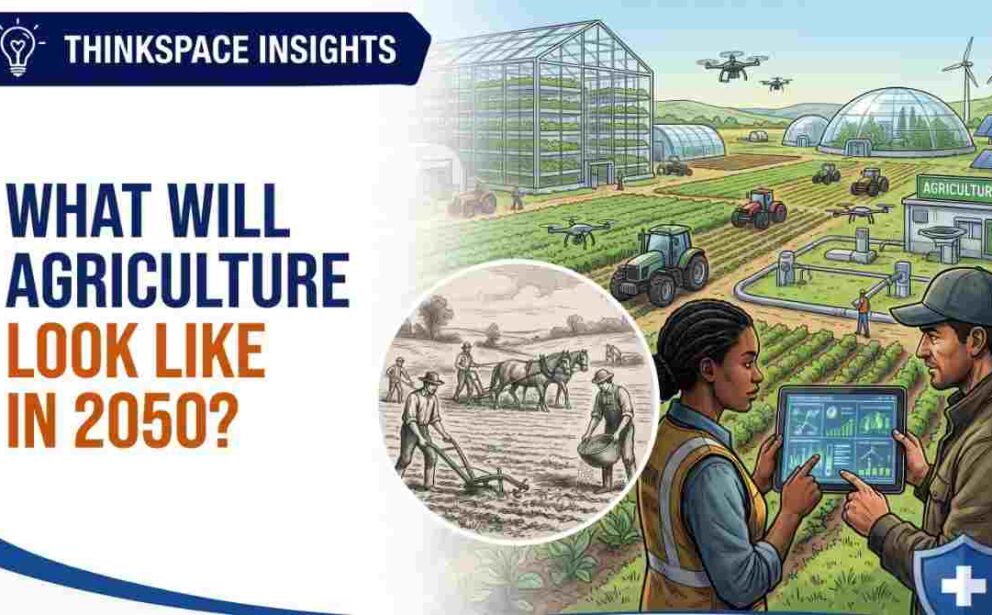
Think about how a modern smartphone replaced a dozen individual gadgets—cameras, maps, calculators, and calendars—by integrating them into one hyper-connected system. Modern agriculture is undergoing a very similar upgrade. We are moving away from traditional, isolated farming into “smart agribusiness,” a system where fields are monitored by interconnected drones, sensors, and artificial intelligence. When researchers talk about the “hyper-specialization” of regional production, they simply mean that farms of the future will not try to grow a little bit of everything for everyone; instead, they will use advanced tech to grow specific crops tailored perfectly to their local climate and specific consumer demands (a concept known as “hyper-segmentation”). Understanding these shifts helps clarify exactly how the world plans to feed its rapidly growing population over the next few decades while navigating a changing climate.
The agri-food sector and agribusiness are utterly essential for human survival, producing all of our food products, raw materials for energy, medicines, fibers, and construction materials. While the global food supply has more than doubled over the past 50 years, critical sustainable development goals related to eradicating hunger and poverty remain unmet. Furthermore, the industry has struggled to optimize its use of land and resources to improve global quality of life. To map out where the industry must go, researchers Juan Manuel Vargas-Canales, Yolanda Sánchez-Torres, and their team analyzed the current dynamics, technological advances, and future configuration of global agri-food systems.
Their research reveals that by the year 2050, the agri-food sector will be completely transformed by four primary forces. First, sweeping demographic trends—including massive population growth, aging populations, mass migration, and increasing urbanization—will drastically alter global food demand. Second, global economic growth and rising incomes will force the industry to heavily diversify what it produces. Third, the harsh limits of our planetary system, marked by severe natural resource scarcity, environmental degradation, and climate change, will aggressively threaten planetary stability. Finally, to cope with these immense pressures, the future of farming will be defined by profound technological advancements, specifically the widespread integration of drones, sensors, robotics, artificial intelligence, and hyperconnectivity for real-time decision-making.
Driven by these technological leaps and new consumer demands, the agri-food sector is steering toward the hyper-specialization of regional production. To survive and thrive in this highly segmented market, agricultural businesses must evolve into smarter, more efficient, and equitable operations. The researchers propose that achieving this requires developing much greater technological capabilities and integrating digital tools directly into administration and management. Above all, the industry must prioritize technological strategies specifically designed to promote the healing, recovery, and long-term improvement of our essential agri-food systems.
ThinkSpace Insights
- Essential but struggling: While the global food supply has doubled in 50 years, the agri-food sector has not yet met critical sustainability goals related to poverty, hunger, and resource optimization.
- Four forces of change: By 2050, the agricultural industry will be fundamentally reshaped by changing demographics, economic growth, planetary resource limits, and rapid technological advancement.
- The rise of smart farming: The widespread adoption of drones, sensors, robotics, and artificial intelligence will become standard for real-time agricultural decision-making and automation.
- Hyper-specialized production: The sector is shifting toward highly specialized regional farming to perfectly meet the diverse, segmented demands of modern consumers.
- Digital integration is mandatory: Future agribusinesses must integrate advanced digital technologies into their core management and administration to remain efficient, adaptable, and resilient.
- Healing the system: New technological strategies must explicitly prioritize the ecological recovery, healing, and long-term improvement of agricultural lands.
Access Full Article