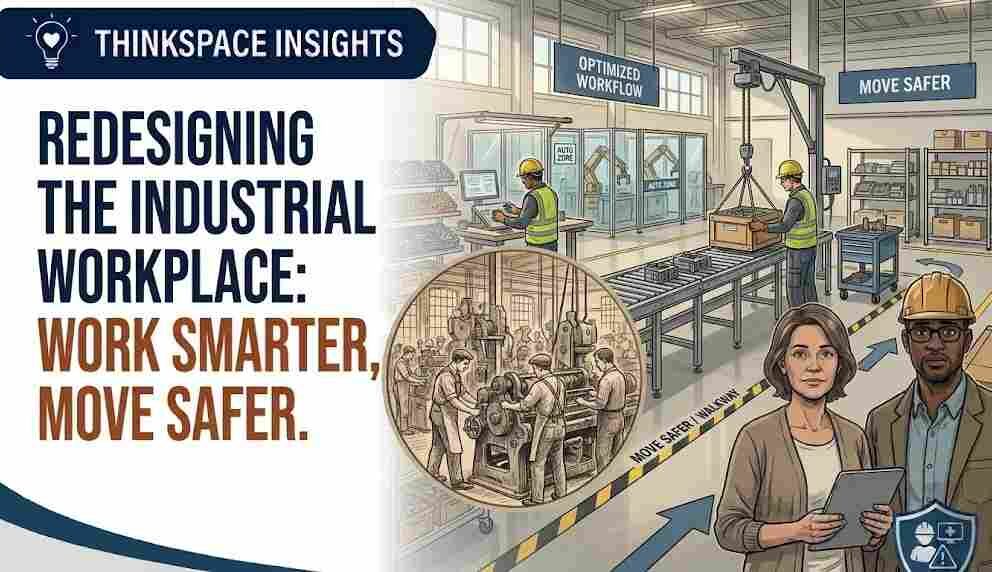
Think of a professional athlete performing a complex maneuver; they train endlessly to eliminate wasted movement, knowing that awkward posture or unnecessary reaching will lead to a career-ending injury. In the modern industrial workplace, everyday workers are performing their own complex physical maneuvers, yet we rarely train them with the same biomechanical rigor. While safety engineering often treats the human body as an infinitely adaptable machine, this is a dangerous fallacy. When a worker must compensate for a poorly designed, inefficient workspace, they are forced to pay for that inefficiency with their own musculoskeletal health. To stop this silent epidemic of workplace injuries, safety professionals are revisiting the century-old principles of “motion economy” to fundamentally redesign how work is performed.
Historically, the concepts of “efficiency” and “safety” have been treated as separate domains. Efficiency was viewed strictly through the lens of industrial output and speed, while safety was focused on compliance, incident reporting, and handing out Personal Protective Equipment (PPE). However, this separation ignores the very mechanics of how work is actually performed. The most common workplace injuries—such as soft-tissue strains, carpal tunnel syndrome, and chronic back pain—are not caused by sudden accidents. They are cumulative injuries, resulting from thousands of micro-traumas caused by poor posture, awkward reaching, and repetitive exertion.
To bridge this gap, Francesco Jose Addabbo authored a comprehensive guide in Occupational Health & Safety, exploring how the historical principles of motion study can be used as a potent instrument for identifying ergonomic risk factors. The methodology relies on dissecting work into 18 foundational physical elements known as “therbligs”—the basic atoms of human motion, such as “Reach,” “Move,” “Grasp,” and “Position”. By breaking down a task into these specific micro-movements, a safety professional can pinpoint exactly where the injury potential exists, transforming safety from a reactive process of dealing with injuries into a proactive process of designing hazards out of the workflow.
Applying these principles involves simple, logical rules categorized into three domains: the use of the human body, the arrangement of the workplace, and the design of tools. For example, ensuring that a working surface is at the proper elbow height prevents unnecessary hunching, while establishing fixed locations for tools eliminates the wasted, fatiguing motion of searching. In field operations, simply switching from a heavy, shoulder-slung bag to a wheeled cart can shift the load-bearing requirements off a worker’s spine, vastly reducing physical fatigue.
However, measuring this physical toll is no longer limited to subjective observation. Today’s safety professionals have access to wearable technology, such as posture-correction sensors and smart insoles, which act as “always-on” observers to provide real-time bio-feedback. When used as a support tool rather than a surveillance mechanism, these wearables provide the objective data needed to pinpoint exactly which tasks are causing the highest physical stress. This is critical, as physical fatigue directly depletes a worker’s cognitive resources, making them less observant, slower to react, and highly prone to accidents.
Ultimately, the principles of motion economy prove that efficiency and safety are inextricably linked. If work is designed to be inefficient, it is inherently designed to be dangerous. By adopting this safety-first lens, organizations can stop viewing ergonomics as a luxury and recognize it as a fundamental requirement for operational success. The goal is no longer just to maintain compliance, but to create a sustainable work environment that actively preserves the physical and mental capital of the workforce.
ThinkSpace Insights
- The biomechanical tax, highlighting that when workers compensate for inefficient workspaces by reaching or bending unnecessarily, they incur a physical debt that leads to musculoskeletal disorders.
- Cumulative trauma, noting that common injuries like chronic back pain and soft-tissue strains are not sudden accidents, but the result of thousands of micro-traumas caused by poor movement.
- The atoms of motion, explaining how safety professionals dissect tasks into 18 foundational elements called “therbligs” to pinpoint exactly where injury potential exists.
- Rules of engagement, detailing how simple adjustments—like setting proper working heights and fixing tool locations—can optimize human performance and reduce physical strain.
- Wearable bio-feedback, revealing that modern safety teams use wearable sensors to objectively track physical stress and pinpoint hazardous tasks without relying on subjective observation.
- The fatigue-error cycle, warning that physical exhaustion directly depletes cognitive resources, making workers less observant and significantly more prone to accidents.
Access Full Article