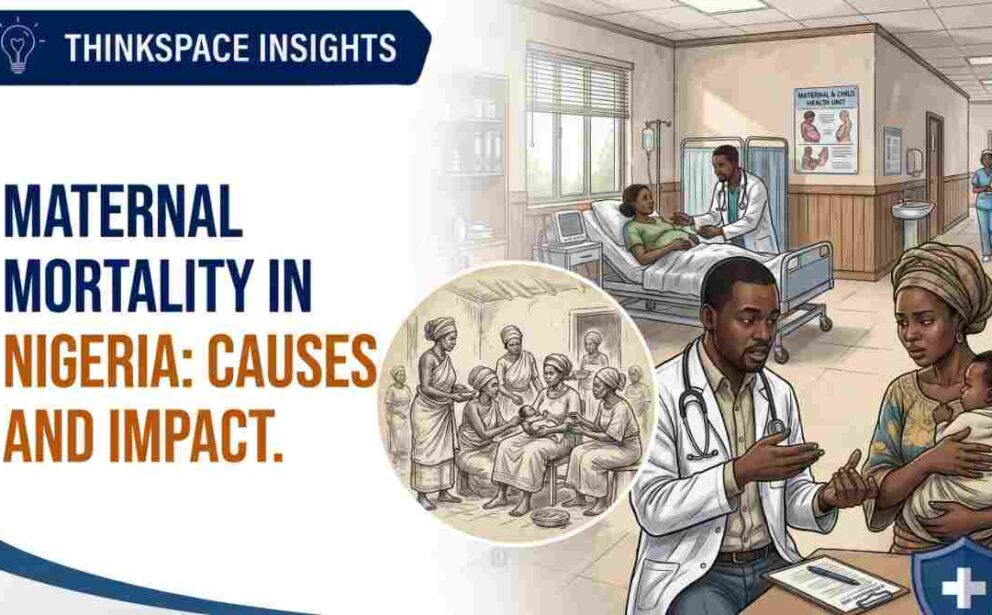
Imagine an intricate web of roadways where a single collapsed bridge doesn’t just stop traffic—it paralyzes the trade, health, and daily survival of every surrounding community. In a developing nation, a mother is that vital bridge. However, when maternal healthcare fails, the resulting “maternal mortality” (a pregnancy-related death) has devastating, far-reaching effects on the socio-economic development of the entire society. Yet, despite global commitments to improve maternal and child health, the loss of women’s lives from preventable pregnancy complications has continued to increase in many sub-Saharan African countries, specifically in Nigeria. Unpacking the exact socioeconomic factors and system failures driving this crisis is crucial for any nation seeking to secure its future.
The statistics surrounding this crisis paint a stark and deeply concerning picture. According to the World Health Organization, approximately 830 women die every day globally from preventable causes related to pregnancy and childbirth, with a shocking 99% of these deaths occurring in developing countries. To understand the local reality, researchers Olawale Olonade, Tomike I. Olawande, and their colleagues analyzed the maternal healthcare system in Nigeria. The study highlights a grim national baseline: Nigeria ranks second globally in maternal incident rates, registering a tragic rate of 545 deaths per 100,000 live births. Strikingly, this means there is at least one case of maternal mortality in every 20 live births—making Nigerian women 500 times more likely to lose their lives in childbirth compared to those in advanced nations.
The researchers utilized a functionalist perspective to examine the interrelated factors driving these high mortality rates, finding that the crisis goes far beyond basic medicine. Aside from direct medical causes, certain socio-cultural and socioeconomic factors heavily influence the outcome of pregnancy. Factors such as poverty, lack of education, and gender relations dictate whether a woman can access care, while a poor healthcare system—which is a consequence of a weak social structure—acts as a massive contributing factor. When a woman dies, it affects her family’s ability to participate in the labor force, reduces national life expectancy, and strains budgets with perpetual crisis management rather than diversifying resources for development.
Both maternal and infant mortality rates serve as social indicators used to measure the overall development of any country, and the situation in Nigeria is of great concern. In spite of the resolution and adoption of the Sustainable Development Goals (SDGs), the loss of women’s lives from pregnancy complications continues to hold back progress. Ultimately, the study emphasizes that maternal mortality is a preventable crisis that requires a unified, proactive response. To safeguard the future, governments must prioritize the eradication of poverty and improve the maternal healthcare system to ensure sustainable development. By prioritizing the lives of mothers and ensuring equitable access to advanced healthcare, we can finally begin to heal the fragile social and economic structures of our society.
ThinkSpace Insights
- A preventable crisis, as maternal mortality has debilitating effects on the socioeconomic development of any nation, yet remains stubbornly high in developing regions.
- Nigeria hit hardest, noting that Nigeria ranks second globally in maternal incident rates, recording a tragic rate of 545 deaths per 100,000 live births.
- Beyond medicine, highlighting that socio-cultural and socioeconomic factors like poverty and lack of education heavily influence pregnancy outcomes and access to care.
- The tragic ratio, revealing that roughly 1 in every 20 live births in Nigeria results in maternal mortality, compared to much lower ratios in advanced nations.
- Impacting future growth, as maternal deaths tear apart family units and drag down overall socio-economic development, serving as a critical indicator of a country’s progress.
- Urgent system reforms, concluding that governments must improve maternal health systems and eradicate poverty to ensure sustainable development.
Access Full Article