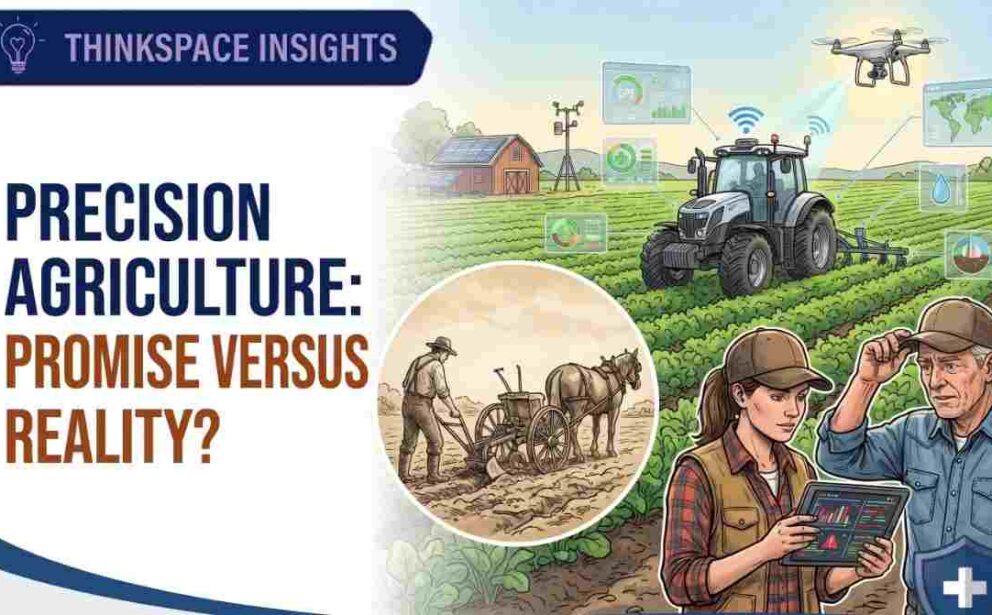
Imagine buying a highly advanced, automated smart-home system to save money on your heating bill. While the new thermostat brilliantly optimizes the temperature and drastically cuts your gas usage, you soon realize the massive computer servers required to run the system are using more electricity than you ever saved in gas. In the agricultural sector, farmers adopting “precision agriculture” (PA) are running into a remarkably similar paradox. While advanced technologies like drones, sensors, and robots are heavily promoted for their ability to streamline farming, the reality of implementing them on real-world soil often reveals unexpected trade-offs.
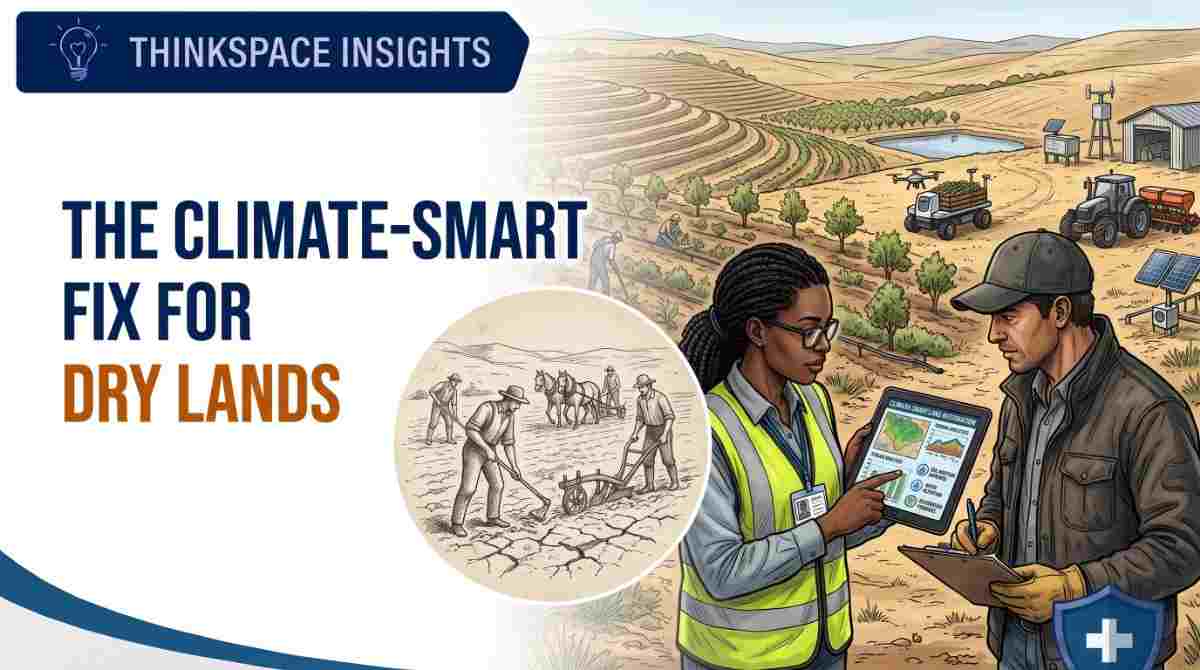
Smart and connected technologies hold considerable promise for modernizing agriculture, particularly in rural areas facing severe infrastructure and resource constraints. Proponents argue that precision agriculture—which utilizes real-time monitoring, automation, and data-driven decision making—can drastically reduce waste, optimize chemical inputs, and improve crop yields. From an environmental standpoint, optimizing irrigation and utilizing drones for site-specific herbicide applications can theoretically save massive amounts of water and decrease physical labor needs. However, the agricultural industry is beginning to realize that the theoretical promises of the laboratory do not always survive the harsh realities of the farm.
To investigate this disconnect, researcher Annabel Oosterwijk and a team of experts conducted a critical review comparing the theoretical promises of precision agriculture with its actual real-world impacts. Published in the Journal of Rural Studies, their study aimed to identify the environmental, economic, and social convergences and divergences between technological theory and agricultural practice. The researchers combined a comprehensive literature review with a practical case study, analyzing a multi-robot, sensor-based irrigation system deployed on a remote, smallholder farm in the Isles of Scilly, UK.
The findings revealed several stark trade-offs that completely upended theoretical expectations. On the environmental front, the advanced sensor-based irrigation system successfully reduced the farm’s water demand by an impressive 29%. However, the continuous power required to run the digital components caused the system’s electricity use to significantly increase, inadvertently amplifying the farm’s overall carbon emissions. This highlights a crucial mechanical reality: the environmental gains of digital farming can be completely undermined if the technology relies on unsustainable power demands to function.
Economically and socially, the real-world implementation also fell short of the automated dream. While the academic literature frequently champions precision agriculture for creating massive labor savings and boosting community benefits, the case study proved otherwise. The anticipated reduction in manual labor was entirely offset by a new, expensive need for specialized supervision to manage the complex robotic systems, ultimately raising operational costs. Furthermore, the adoption of these technologies shifted the farmer’s role from a manual operator to a systems manager, introducing new systemic vulnerabilities like a heavy dependency on external agritech platforms and a demanding need for high digital literacy.
Ultimately, this study serves as a vital reality check for the future of digital farming. The researchers conclude that while precision agriculture offers incredible tools, realizing its full value requires looking far beyond just technical performance. To ensure that digital farming supports rural communities rather than bankrupting them, developers and policymakers must pay acute attention to energy trade-offs, true cost-effectiveness, and equitable implementation. By designing technologies that adapt to the context of smallholder farms, the agricultural sector can successfully bridge the gap between high-tech theory and down-to-earth practice.
ThinkSpace Insights
- The smart farm paradox, as precision agriculture technologies often present unexpected environmental and economic trade-offs when deployed in real-world settings.
- Comparing theory and practice, with researchers analyzing a multi-robot irrigation system in the UK to contrast theoretical promises against actual farming outcomes.
- Saving water, burning carbon, revealing that while sensor-based irrigation reduced water demand by 29%, it significantly increased electricity use and amplified carbon emissions.
- The hidden labor costs, noting that anticipated labor savings were completely offset by the expensive need for specialized supervision to manage the complex robotic systems.
- Shifting farmer roles, highlighting that precision agriculture forces manual operators to become systems managers, requiring higher digital literacy and creating dependency on agritech providers.
- A call for context, concluding that successful agricultural technology must prioritize energy trade-offs and true cost-effectiveness to genuinely support smallholder and remote rural communities.
Access Full Article