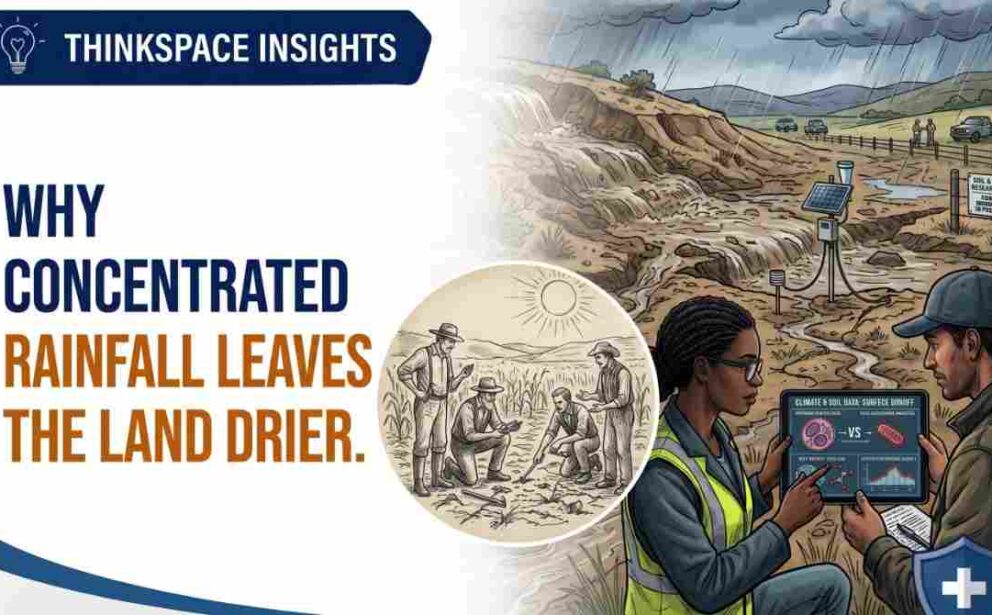
If you try to water a delicate potted plant with a high-pressure firehose for ten seconds, the vast majority of the water will violently splash over the edges, washing away the topsoil while leaving the deep roots completely dry. If you take that exact same volume of water and apply it through a slow drip over several hours, the soil will absorb every drop. This simple concept explains a terrifying new reality regarding global climate change. As the planet warms, the Earth’s precipitation is becoming heavily concentrated into fewer, massive, and highly intense rainstorms, separated by much longer dry intervals. While it might seem like more intense rain would make the land wetter, scientists are discovering that this “firehose” effect is actually severely decreasing the amount of water successfully stored in the earth.
Terrestrial water availability is a foundational determinant of both human and ecosystem well-being. Historically, debates over future global aridity have focused almost entirely on the simple climatological balance between mean precipitation and evaporation. Meanwhile, research regarding the intensification of rainfall has generally centered on the immediate, physical threat of flood risks. However, until recently, it was largely unknown exactly how the daily-scale concentration of rain into fewer, heavier events actually affects hydrologic partitioning and the long-term water balance of the land.
To solve this critical environmental mystery, researchers Corey S. Lesk and Justin E. Mankin conducted a comprehensive global analysis of the Earth’s shifting land water balance. They recognized that the asymmetry in global precipitation distribution means that a tiny minority of days contribute the most to our annual rainfall, and these extreme high-percentile days are over three times more sensitive to global warming than average mean precipitation. The researchers sought to definitively measure how this shift toward concentrated, localized rainfall events alters the long-term retention of terrestrial water.
The observational findings of the study present a counterintuitive and highly alarming reality. The data observationally proves that more concentrated precipitation actively decreases land water availability across all climates globally. In fact, the research demonstrates that the severe drying effect caused by this rainfall concentration is just as strong in magnitude as the wetting effect caused by an overall increase in total precipitation. Essentially, even if a region receives more total rain over a year, the violent, concentrated nature of how it falls leaves the land drier than before.
To understand why this happens, the researchers utilized both simple and complex land-surface models, successfully recreating the observed drying effect in idealized simulations. They found that the terrestrial water loss arises primarily from enhanced evaporation caused by dangerous changes in hydrologic partitioning at the land surface. When rain falls too intensely, the soil reaches saturation immediately, causing the excess water to be lost as runoff into rivers rather than infiltrating the deep earth. Subsequently, the extended dry intervals between these rare storms create the perfect, energetic space for massive evapotranspiration to suck the remaining moisture back out of the ground.
The future implications of this concentrated precipitation are devastating for global water security. The researchers project that at about 2 °C of global warming, this rainfall concentration will violently shift the land surface to abnormally dry conditions for a staggering 27% of the global human population. Crucially, this massive drying effect will occur completely independent of any changes to total precipitation or human irrigation efforts. These results introduce a vital new determinant of the land water balance, proving that the future of human water availability depends just as much on the exact timing of the rain as it does on the total amount.
ThinkSpace Insights
- The firehose effect, revealing that as global warming forces rain and snow into fewer, highly intense events, terrestrial water storage actually decreases across all climates.
- Equal and opposite forces, showing observationally that the severe drying effect caused by concentrated precipitation is as strong in magnitude as the wetting effect of increased total rainfall.
- Runoff replaces absorption, explaining that intense rainfall rapidly saturates the topsoil, forcing the vital water to run off the land rather than infiltrating deeply into the earth.
- Evaporation accelerates, as the longer, hotter dry intervals between these concentrated rainstorms create the perfect energetic conditions for enhanced evapotranspiration.
- A global dry spell, projecting that at just 2 °C of warming, precipitation concentration will force abnormally dry conditions upon 27% of the global population.
- Timing matters most, concluding that the long-term terrestrial water balance is highly sensitive to the temporal distribution of rainfall, independent of total precipitation volume.
Access Full Article