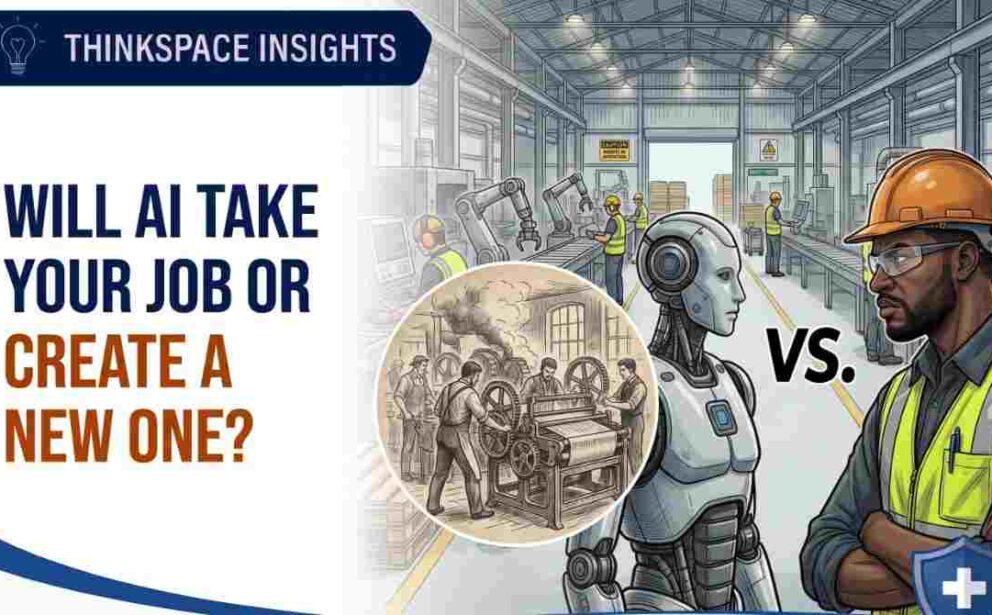
The idea of machines replacing human workers is arguably the most pressing economic and social debate of the modern era. Following a long evolution from the early days of the Turing Test to modern deep learning, Generative Artificial Intelligence (GenAI) has crossed a critical threshold. Today, these advanced models possess the unprecedented ability to autonomously collect data, generate complex content, solve problems, and perform tasks that historically required nuanced human reasoning.
This rapid expansion of technological capability has sparked intense anxiety across the global workforce. Employees and policymakers share widespread concerns about rising unemployment, fearing that algorithms will render entire industries obsolete overnight. Conversely, corporate leaders and technologists point to massive positive perspectives, arguing that this technology will liberate humans from drudgery. To cut through the panic and hype, researchers conducted a systematic review to determine exactly how GenAI will realistically impact the future labor market.
To build an objective forecast, the researchers systematically searched major scientific databases like PubMed, Scopus, and Web of Science. Following strict PRISMA guidelines, the team ultimately selected 14 comprehensive, peer-reviewed articles for deep analysis. This systematic methodology allowed the researchers to carefully weigh the projected positive efficiencies of GenAI against the inevitable negative disruptions it will cause to existing employment structures.
The findings confirm that the economic incentives to adopt AI are simply too massive for businesses to ignore. The reviewed studies show that when GenAI is implemented in a manner compliant with strict security and ethical standards, it possesses the profound potential to drastically increase organizational efficiency. By automating repetitive cognitive tasks, businesses can significantly reduce operational costs and dramatically accelerate production times.
However, the impact on the human workforce will be deeply polarized and highly disruptive. The researchers conclude that GenAI is not a simple job-killer, but rather a profound market re-organizer. The technology is highly likely to create entirely new, specialized roles in certain tech-forward sectors, while simultaneously and permanently reducing employment opportunities in more traditional fields.
Because of this rapid and uneven growth, society cannot afford a passive approach to this technological revolution. The study heavily urges organizations and governments to conduct nuanced assessments of how AI will impact their specific sectors. To survive the transition, institutions must prioritize ongoing monitoring, guide aggressive organizational planning, and rapidly improve AI governance frameworks to prepare the workforce for an evolving landscape dominated by advanced algorithms.
ThinkSpace Insights
- Autonomy in the office, highlighting that GenAI can now autonomously process data, generate content, and perform complex tasks that traditionally required human reasoning.
- A dual-edged sword, as a systematic review explores both the widespread concerns about rising unemployment and the positive perspectives on technological efficiency.
- Rigorous analysis, utilizing strict PRISMA guidelines to synthesize the findings of 14 comprehensive studies regarding the future of the job market.
- Massive efficiency gains, finding that when properly regulated for security and ethics, GenAI drastically reduces operational costs and time for organizations.
- Shifting job landscapes, concluding that the technology will inevitably create new roles in emerging sectors while simultaneously reducing opportunities in traditional fields.
- The need for adaptation, emphasizing that ongoing monitoring, AI governance, and proactive organizational planning are vital to help the labor market survive this transition.
Access Full Article