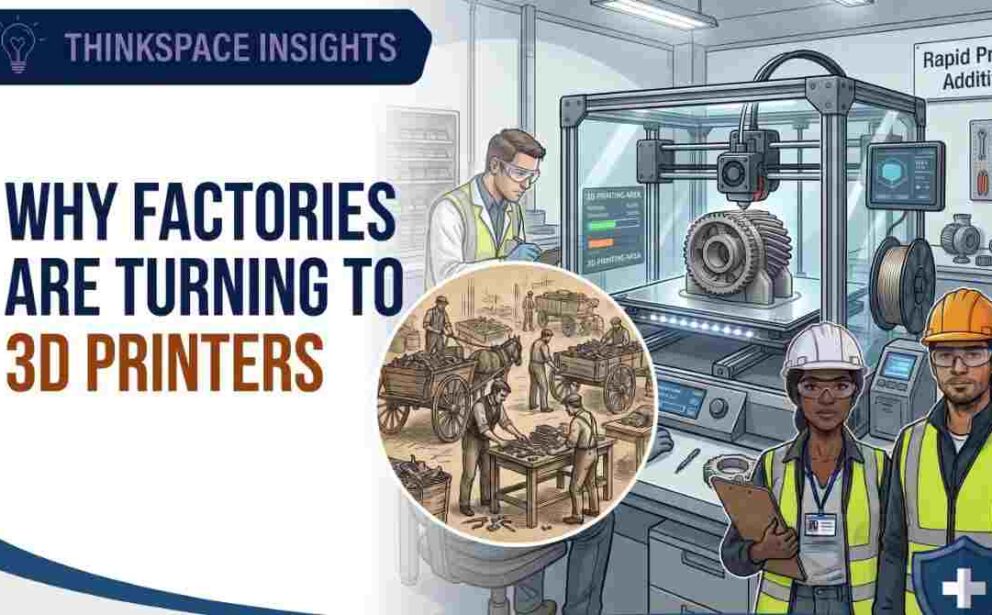
Think of a sculptor chiseling away at a block of marble; to create a final statue, they must remove and waste large amounts of material. Traditional manufacturing operates in much the same way, cutting down large blocks of metal or plastic to create a final usable part. But what if the sculptor could simply conjure the statue out of thin air, adding material only exactly where it is needed? This is the fundamental magic of “additive manufacturing,” commonly known as 3D printing. Over the past three decades, this technology has evolved from an experimental method used solely for making quick prototypes into a widely adopted, highly disruptive industrial technology.
Traditional supply chains and manufacturing methods are facing immense modern pressures. Global industries are constantly battling with massive tooling costs, wasteful material inefficiency, and rigid supply chains that cannot easily adapt to changing consumer demands. Furthermore, conventional manufacturing severely restricts the physical design of products, as certain complex geometric shapes are physically impossible to create using standard cutting or molding tools. To survive in a highly competitive, fast-paced global market, industries urgently need a production approach that allows for greater geometric complexity, reduced tooling needs, and vastly improved material efficiency.
To understand exactly how this technology is fundamentally reshaping the modern supply chain, researcher I.U. Mammadkhanov conducted a comprehensive review of its industrial integration. Published in 7universum, the study synthesizes key literature and practical findings to review the major applications of 3D printing across sectors such as automotive, aerospace, healthcare, construction, tooling, and spare parts management. The primary objective of the research was to analyze both the key advantages and the current limitations of additive manufacturing from a strictly practical, industrial perspective.
The core mechanism that makes 3D printing so revolutionary is its layer-by-layer fabrication directly from digital models. The review findings show that by utilizing this digital-to-physical process, additive manufacturing effectively enables rapid, on-demand production. This unique capability allows engineers to create highly complex geometries that go far beyond the limits of conventional methods. Consequently, it allows modern industries to support highly cost-efficient, low-volume production runs and enables unprecedented levels of mass customization for end-use functional parts.
Beyond just making complex parts, this technology completely transforms how businesses handle global logistics. The study highlights that 3D printing massively improves supply chain flexibility by allowing companies to maintain “digital inventories”—storing part designs on a hard drive and printing them on-demand rather than warehousing massive amounts of physical stock. However, the researcher warns that significant challenges currently restrict its wider adoption. The industrial rollout is actively hindered by severe material limitations, ongoing issues with process reliability, and massive hurdles regarding strict quality control and official certification.
Ultimately, while the era of the 3D-printed factory has begun, it is not yet without its friction points. The study concludes that additive manufacturing has undeniably become an integral part of the modern industrial landscape. Yet, moving forward, its broader implementation across all sectors will depend entirely on overcoming these current operational barriers. To fully unlock the potential of digital inventories and mass customization, the industry requires further technological advancements in material science alongside the rapid development of standardized regulatory frameworks.
ThinkSpace Insights
- Building layer by layer, as additive manufacturing constructs complex parts directly from digital models, vastly improving material efficiency compared to conventional methods.
- A major industrial shift, noting that 3D printing has successfully evolved from a niche rapid prototyping tool into a widely adopted technology across aerospace, automotive, and healthcare sectors.
- Unlocking complex geometries, highlighting that the technology enables the creation of highly intricate shapes that are completely impossible to manufacture using traditional tools.
- The digital inventory, revealing that 3D printing improves supply chain flexibility by allowing companies to print spare parts on demand rather than physically warehousing them.
- Mass customization, explaining how the reduction in expensive tooling needs allows for highly cost-efficient, low-volume production runs tailored to specific consumer requirements.
- Barriers to adoption, cautioning that widespread industrial implementation is currently restricted by severe material limitations, process reliability issues, and strict quality certification hurdles.
Access Full Article