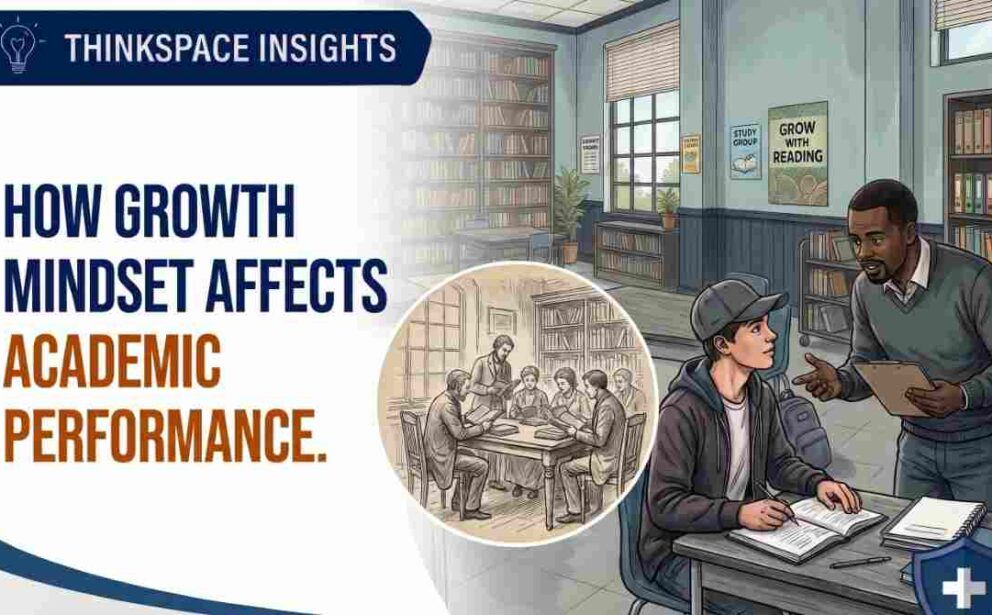
Think of a student’s brain like a smartphone. If the student believes their intelligence is a fixed, unchangeable hardware specification, they will never try to run a demanding new application for fear of crashing. Conversely, if a student views their intelligence as a flexible operating system that can be continuously upgraded through effort, they will actively seek out challenging new software. In educational psychology, this flexible operating system is known as a “growth mindset”—the belief that intelligence is a highly malleable feature rather than a stable, innate trait. Students armed with this mindset take much greater advantage of learning opportunities and demonstrate significantly higher persistence in their schoolwork. Understanding how this specific psychological trait impacts long-term academic success is becoming a major priority for educators looking to reduce dropout rates.
While it is a well-established fact that a student’s grade point average (GPA) from lower secondary school is a strong predictor of whether they will successfully complete upper secondary school, the underlying role of socio-emotional skills in this transition has remained largely underexplored. Historically, nationwide educational interventions aimed at increasing graduation rates have heavily targeted the strengthening of basic academic skills, particularly among the lowest-performing demographics. However, this strict emphasis on basic skills training has frequently failed to yield the intended positive effects for students at the very lowest achievement levels.
To bridge this critical knowledge gap, researcher Elin Svensen conducted a massive multilevel analysis investigating the precise relationship between socio-emotional skills and academic achievement. The study meticulously tracked a cohort of 9,477 Norwegian students who were actively transitioning from lower secondary to upper secondary school. The primary aim of this extensive empirical investigation was to determine to what extent a growth mindset actually predicts the successful completion of a student’s critical first year in upper secondary education.
The findings of the study definitively proved that holding a growth mindset provides a massive, tangible advantage in the classroom. Initially, the data revealed a strong positive association between a student possessing a growth mindset and their prior academic performance, a trend that held true for both boys and girls. This indicates that students who fundamentally believe they can improve are naturally more likely to have achieved higher grades in their earlier schooling.
However, the most groundbreaking revelation occurred when researchers controlled for previous academic success. The study found that holding more of a growth mindset significantly predicts the actual completion of upper secondary school, even when comparing students who had identical GPAs from their lower secondary education. This proves that when two students possess the exact same level of baseline academic knowledge, the student who believes their intelligence can grow is statistically much more likely to survive the difficult transition and stay in school.
Crucially, the data showed that this psychological advantage is not distributed evenly across the student body. The positive impact of a growth mindset is actually significantly more pronounced for lower-performing students than for their high-achieving peers. These compelling results strongly underscore the absolute importance of integrating socio-emotional skill development into standard educational outcomes, proving that teaching struggling students how to think about their own potential may be just as vital as teaching them basic math or reading skills.
ThinkSpace Insights
- Intelligence is malleable, as a growth mindset is defined by the core belief that intelligence can be developed, leading students to show higher persistence and take better advantage of learning opportunities.
- A massive sample size, with the empirical study carefully tracking the academic progress of 9,477 Norwegian students transitioning from lower to upper secondary school.
- Mindset predicts graduation, revealing that holding a growth mindset significantly predicts the successful completion of the first year of upper secondary school.
- Outperforming raw grades, showing that a growth mindset remains a strong predictor of school completion even among students who enter with the exact same prior GPAs.
- Bridging the achievement gap, highlighting that the positive impact of possessing a growth mindset is distinctly more pronounced for lower-performing students.
- Beyond basic skills, proving that educational interventions must incorporate socio-emotional skill development because strictly targeting basic academic skills often fails to help the lowest achievers.
Access Full Article