Air pollution is a massive global health crisis, responsible for around 7 million premature deaths annually. Understanding an individual’s actual health risk requires measuring their personal air pollution exposure (PAPE), which is calculated as the product of the pollutant concentration and their minute ventilation. However, standard measurement techniques frequently fall short because they do not address the complex space-time variability of indoor and outdoor air pollution, nor do they account for the massive intra- and intersubject variability in human breathing rates.
To solve this critical measurement gap, researchers Sara Bernasconi, Alessandra Angelucci, Andrea Rossi, and Andrea Aliverti developed and tested a new wearable body sensor network (BSN). This pilot observational study was designed to evaluate the feasibility of using this wearable system to estimate true PAPE in real-life settings. By simultaneously tracking both physiological and environmental data, the researchers aimed to assess the system’s capability to detect spatiotemporal variations in pollution and directly compare its inhaled dose estimates against the traditional data gathered from fixed monitoring stations.
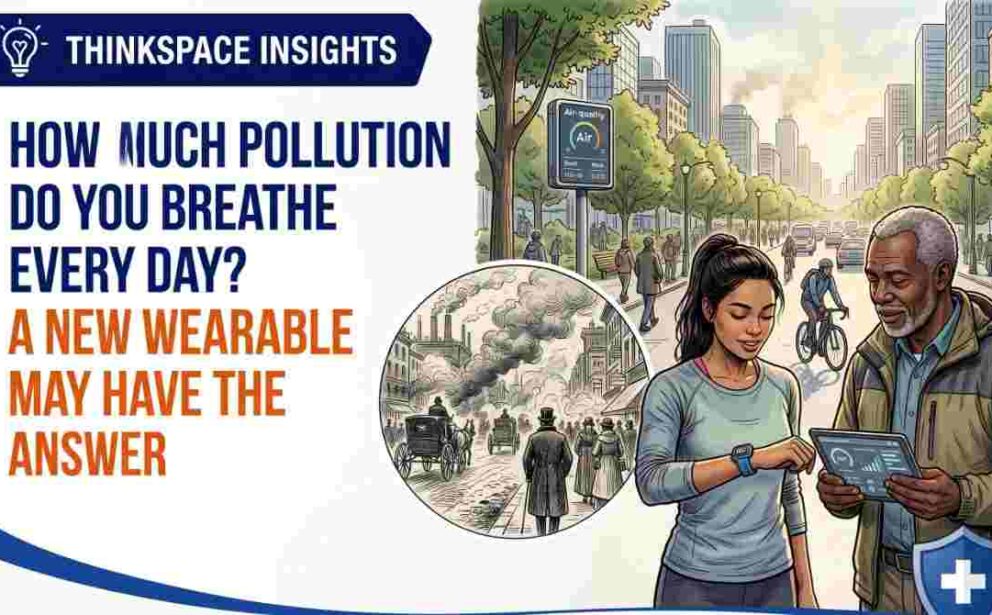
The research team tested this BSN on 20 healthy volunteers who wore the system during a 4.5-kilometer walk through the city of Milan. The wearable technology continuously captured physiological metrics, specifically pulse rate and respiratory rate, alongside a suite of health-affecting pollutants including PM1, PM2.5, PM10, CO2, carbon monoxide, total volatile organic compounds, and NO2. The gathered physiological data was then combined with biometric information and forced vital capacity estimations to accurately compute the volunteers’ minute ventilation and determine their real-world PAPE.
The results highlighted exactly why standard fixed-station measurements are often insufficient for personal health tracking. The study found significant differences in pollutant concentrations based on the time of day; CO2 levels were notably higher in the morning, while PM levels peaked in the afternoon. The environments also drastically changed the pollution profile, as indoor settings showed high variability in CO2 and volatile organic compounds, whereas outdoor settings exhibited elevated and highly variable PM levels. Furthermore, spatial variability was detected along the walking path, and the volunteers’ respiratory rates fluctuated significantly both among different participants and at different locations for the exact same individual.
The most alarming finding from the study was the stark discrepancy in the final exposure estimates. The mean PAPE to PM2.5 estimated using traditional fixed station data and tabulated breathing rates was 13.31 µg, while the wearable BSN estimated a significantly higher exposure of 16.27 µg—a 22.3% increase. While the two estimation methods did show a good and strongly significant correlation, the BSN proved that traditional methods may severely underestimate the true amount of particulate matter a person inhales. With the system’s overall usability rated as good, this wearable technology represents a major leap forward, offering a highly precise tool for individuals to track their true exposure to toxic air.
ThinkSpace Insights
- A massive global threat, with air pollution acting as a major environmental cause of premature death, killing around 7 million people annually.
- Fixed stations miss the details, as standard exposure techniques fail to account for the real-time spatial variability of pollution or the changes in a person’s breathing rate.
- Wearables capture the complete picture, successfully combining real-time physiological data (like pulse and respiratory rates) with environmental pollutants to calculate exact personal exposure.
- Pollution fluctuates constantly, with the study revealing higher CO2 levels in the morning, higher PM in the afternoon, and distinct differences between indoor and outdoor air quality.
- Standard methods underestimate risk, as the wearable BSN revealed that the true inhaled dose of PM2.5 was 22.3% higher than the estimates provided by traditional fixed monitoring stations.
- The technology is practical, with the BSN achieving a “good” usability rating during the 4.5 km walking test in Milan.
Access Full Article