
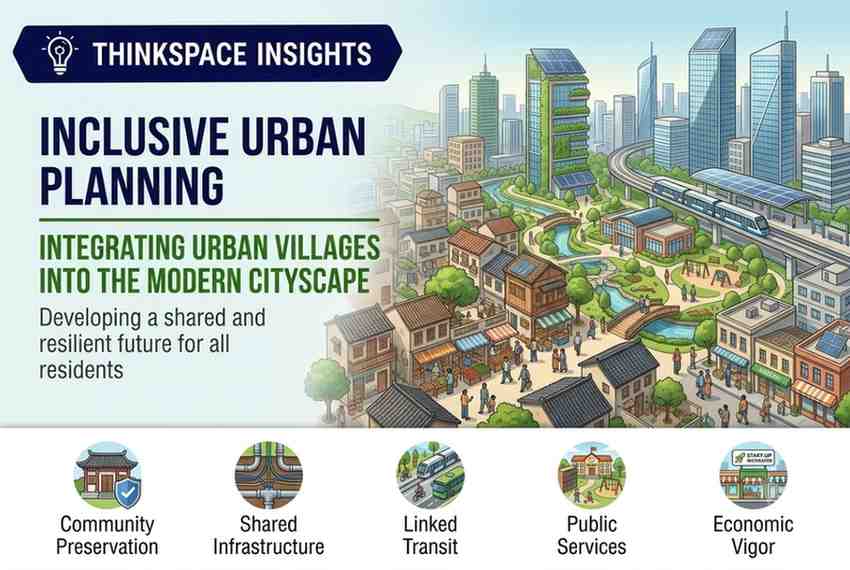
Urban villages—former rural enclaves swallowed up by rapid, unprecedented urbanization—have become a defining phenomenon across many developing nations. Despite their significant, organic contributions to local economies, these high-density, mixed-use zones are frequently overlooked by formal policymakers. Consequently, integration into official municipal frameworks remains a major structural hurdle, leaving many urban villages to endure substandard built environments, inadequate infrastructure, and severe socio-spatial segregation from the formal urban core.
To unpack how global planning dynamics either heal or worsen this divide, a comprehensive study by researchers Pranavi Kasula, Aysin Dedekorkut-Howes, Heather Shearer, and Scott Baum conducts a Systematic Quantitative Literature Review (SQLR). Their research analyzes global urban planning practices through a distinct thematic lens, mapping the precise socio-political forces that drive the social inclusion or exclusion of these unique neighborhoods, particularly within the Global South.
The study highlights a critical warning regarding traditional urban renewal strategies. The authors reveal that common municipal interventions—such as aggressive demolition-led redevelopment, rigid incremental upgradation, and unsupported self-help mechanisms—frequently operate as exclusionary paradigms. Instead of resolving structural inequalities, these top-down methods break up established neighborhoods and push vulnerable communities further to the margins of society.
Conversely, the review synthesizes the global literature to identify five highly effective pathways toward genuine social inclusion: targeted urban design and placemaking, in-situ (on-site) redevelopment, community-driven incrementalism, responsive governance, and structured socio-economic support systems. Moving forward, the authors call for a profound paradigm shift away from real estate policies that prioritize corporate economic growth over human welfare. To build truly equitable cities, future frameworks must champion context-specific, participatory planning models that elevate the lived experiences of residents. Furthermore, the paper highlights glaring geographic and linguistic gaps in current academic literature, urging the global research community to deploy multi-lingual, cross-context comparative case studies to capture underrepresented perspectives from the world’s fastest-growing urban centers.
ThinkSpace Insights
- Urban villages represent a complex dual reality, functioning as vital micro-economic hubs while suffering from severe systemic marginalization and socio-spatial isolation.
- Demolition-led redevelopment acts as an exclusionary trap, erasing organic community networks and worsening the displacement of vulnerable migrant populations.
- Successful urban integration relies on five structural pillars, pairing physical in-situ redevelopment and placemaking with responsive governance and socio-economic safety nets.
- A major paradigm shift is required in municipal planning, transitioning away from prioritizing short-term corporate real estate profits toward human-centric, participatory design.
- Community-driven incrementalism preserves neighborhood identity, ensuring that infrastructure upgrades scale at a pace that matches the actual financial and social capacities of the residents.
- Global urban design research suffers from severe geographic biases, necessitating a broader, multi-lingual research agenda to accurately document underrepresented urban landscapes in the Global South.
Access Full Article
https://www.sciencedirect.com/science/article/pii/S0264275125008121