
The history of industrialization is often told through stories of economic growth, technological advancement, labor movements, and political transformation. Yet, for decades, far less attention has been given to another critical dimension of industrial society: the health consequences of work itself. In The Social History of Occupational Health, Paul Weindling examines the overlooked historical relationship between industrial labor, workplace disease, political power, and worker protection.
Originally first published in 1985 and reissued by Taylor & Francis in 2026, the book is recognized as one of the earliest major works to explore occupational health through the lens of social history. Rather than focusing solely on medical developments, the work situates workplace health hazards within broader political, economic, and social systems that shaped workers’ lives during industrialization.
The book highlights how industrial growth during the nineteenth and twentieth centuries often exposed workers to dangerous environments, hazardous substances, poor ventilation, overcrowded factories, and unsafe machinery. At the same time, legal protections, compensation systems, and workplace safety regulations remained weak, inconsistent, or heavily influenced by political and economic interests.
Weindling explores how debates surrounding occupational diseases and workplace safety became deeply connected to wider social questions about living standards, labor rights, industrial capitalism, and state responsibility. Health risks in factories, mines, and industrial workplaces were not simply medical concerns; they were also political issues tied to power, inequality, and economic priorities.
A major focus of the book is the evolution of industrial compensation systems and occupational safety legislation. The study examines how governments, employers, labor organizations, and medical professionals debated responsibility for workplace injuries and disease. In many cases, workers faced significant barriers when seeking recognition, compensation, or protection for occupational illnesses.
The book also provides international comparisons, particularly between Britain and Germany, exploring how different political systems, labor relations, and social policies influenced occupational health standards. These comparisons reveal how workplace safety often depended not only on scientific understanding but also on political will, labor activism, and broader social reform movements.
Another important contribution of the work is its examination of occupational health within specific historical contexts, including workplace councils under Italian fascism and the working conditions faced by women during World War I. These examples demonstrate how occupational health is shaped by war, political ideology, gender dynamics, and economic restructuring.
The study further highlights how certain worker populations historically faced greater exposure to occupational risks due to limited legal protection, economic vulnerability, or social marginalization. Women workers, industrial laborers, and low-income populations frequently experienced unsafe conditions while having little influence over workplace policy decisions.
Importantly, the book challenges the idea that workplace safety improvements emerged automatically alongside industrial progress. Instead, many occupational health protections resulted from sustained struggles involving labor unions, social reformers, public health advocates, and political negotiations.
ThinkSpace Insights
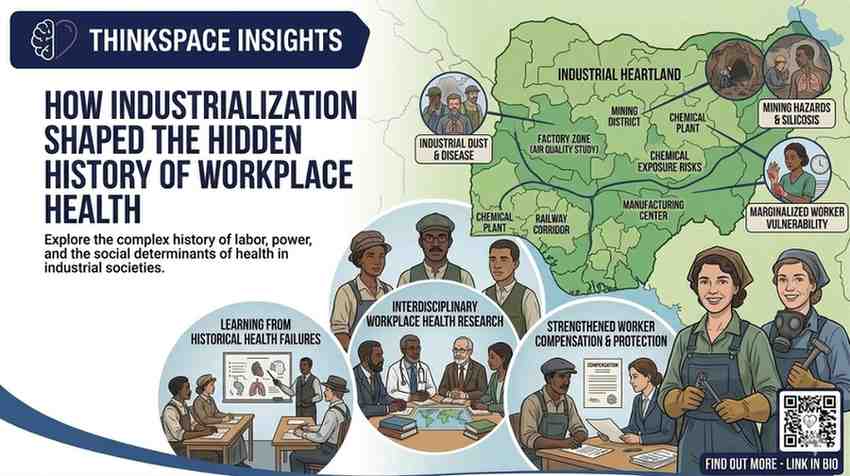
1. Recognize Occupational Health as Both a Medical and Social Issue
Workplace disease and injury are shaped not only by medical factors but also by labor systems, economic structures, political decisions, and social inequality.
2. Strengthen Worker Protection and Safety Regulation
Governments and industries should continue investing in stronger occupational health policies, enforcement systems, and worker-centered safety standards.
3. Address Vulnerabilities Among Marginalized Workers
Low-income workers, informal laborers, women, and vulnerable populations often face disproportionate workplace health risks and require targeted protection.
4. Learn from Historical Occupational Health Failures
Historical analysis can help policymakers and employers better understand the long-term consequences of weak labor protections and delayed safety reforms.
5. Promote Interdisciplinary Approaches to Workplace Health
Occupational health research benefits from collaboration across medicine, public health, sociology, labor studies, economics, and history to fully address workplace well-being. The book ultimately demonstrates that occupational health cannot be separated from broader social and political history. Workplace diseases, industrial injuries, and labor protections evolved through ongoing struggles over power, responsibility, and human welfare during periods of rapid industrial and economic change.
As modern economies continue to confront emerging workplace challenges — including precarious labor, technological transformation, mental health concerns, and occupational inequalities — the historical lessons explored in this work remain highly relevant. Understanding how societies previously responded to workplace hazards may help guide more equitable, humane, and sustainable labor policies in the future.
Read More via https://www.routledge.com/The-Social-History-of-Occupational-Health/Weindling/p/book/9781032925301