
Effective water management is a cornerstone of modern precision agriculture. As the demand for sustainable farming practices grows, Internet of Things (IoT) technologies and advanced machine learning models are stepping up to solve critical challenges. By accurately predicting soil moisture in real-time, these systems ensure that crops receive exactly the water they need, minimizing waste and optimizing overall yields.
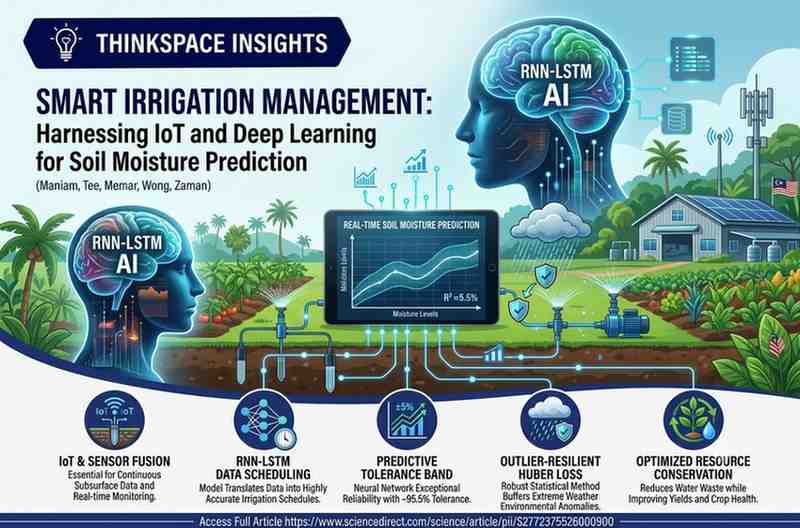
A recent study by Shamala Maniam, Yei-Kheng Tee, Erfan Memar, H.Y. Wong, and Mukter Zaman presents an innovative approach to this challenge. Their research details the development and deployment of an IoT-enabled smart irrigation management system that utilizes subsurface soil moisture sensors. At the core of this system is a powerful recurrent neural network–long short-term memory (RNN-LSTM) model designed specifically to process continuous sensor data and predict soil moisture levels with high precision.
Deployed over a six-month period in Malaysia, the system demonstrated robust predictive capabilities. The RNN-LSTM model achieved impressive accuracy metrics, capturing approximately 67% of the variance in the observed data. More importantly from a practical standpoint, 95.49% of the model’s predictions fell within a strict ±5% tolerance of the actual measured values. This proves that deep learning can successfully translate complex subsurface data into highly reliable and actionable irrigation schedules.
Like any real-world agricultural application, the natural environment presents persistent challenges to data modeling. The authors’ outlier analysis revealed that the largest prediction deviations occurred during heavy, unpredictable rainfall events. To mitigate this, the researchers adopted a robust Huber loss function, which successfully reduced the impact of these extreme weather anomalies and improved the model’s overall coefficient of determination (R²) to 0.70.
Ultimately, this research serves as a vital proof of concept for agricultural engineers and industry professionals looking to implement smart irrigation solutions. While the authors note that future iterations must address spatial variability across larger fields and accommodate broader seasonal changes, the current model stands as a highly effective tool. It provides a clear, practical blueprint for bridging the gap between theoretical deep learning models and real-world agricultural resource conservation.
ThinkSpace Insights
- IoT-enabled smart irrigation systems combined with deep learning are essential for real-time soil moisture prediction and sustainable water management in precision agriculture.
- RNN-LSTM models possess the unique ability to effectively translate continuous subsurface sensor data into highly accurate and actionable irrigation schedules.
- In real-world field tests, the neural network demonstrated exceptional reliability, with over 95% of its predictions falling within a ±5% tolerance of actual soil moisture levels.
- Unpredictable and extreme weather, such as heavy rainfall, remains a primary source of data outliers and a persistent challenge in agricultural predictive modeling.
- Applying robust statistical techniques, like the Huber loss function, can significantly improve model accuracy by buffering the algorithmic impact of environmental anomalies.
- While highly effective for current scheduling needs, future smart irrigation networks must be scaled to accommodate broader spatial variability and diverse seasonal changes.
Access Full Article https://www.sciencedirect.com/science/article/pii/S2772375526000900