
Healthcare systems generate enormous amounts of clinical data every day, yet much of this information remains locked inside unstructured electronic health records (EHRs), making research and analysis slow, expensive, and labor-intensive. A recent study published in JMIR Bioinformatics and Biotechnology explores how generative artificial intelligence (AI) could dramatically improve the speed and efficiency of clinical data extraction.
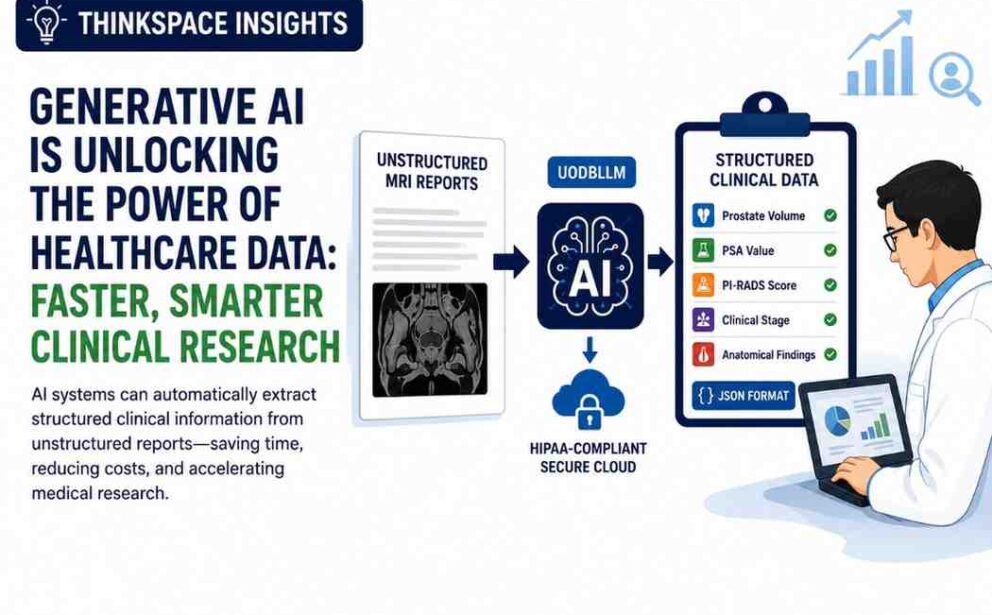
The study, led by Marvin N. Carlisle and colleagues, developed and validated an AI-powered pipeline known as UODBLLM, designed to automatically extract structured clinical information from unstructured medical reports using large language models (LLMs).
Traditionally, extracting detailed clinical information from EHRs requires manual review by researchers or healthcare professionals. This process can take significant time, produce inconsistent results, and limit the scale of clinical research projects. The researchers argue that AI-driven automation may help overcome these barriers while improving research efficiency and scalability.
The study focused on integrating the AI system into an existing clinical outcomes database using Health Insurance Portability and Accountability Act (HIPAA)-compliant cloud services and local open-source language models. The researchers tested the system using magnetic resonance imaging (MRI) reports to evaluate how accurately and efficiently the AI could extract clinical data.
The findings demonstrated strong performance across several key measures. UODBLLM processed 1,800 clinical documents with a 100% completion rate and an average processing time of approximately 8.9 seconds per report. The system also maintained consistent performance across multiple batches, demonstrating scalability for larger research projects.
Importantly, the AI pipeline successfully extracted 16 different structured clinical elements from each MRI report. These included:
- Prostate volume measurements
- Prostate-specific antigen (PSA) values
- Prostate Imaging Reporting and Data System (PI-RADS) scores
- Clinical staging information
- Anatomical assessments
All extracted information was automatically validated using predefined data schemas and stored in standardized JSON format, improving consistency and reducing manual processing errors.
One of the study’s most notable findings was the low operational cost of the system. Researchers reported an estimated processing cost of approximately US $0.009 per report, suggesting that large-scale automated data extraction may become economically feasible for healthcare systems and research institutions.
The study also highlights the growing role of generative AI in biomedical informatics and clinical research. By automating repetitive data extraction tasks, AI systems could allow researchers and healthcare professionals to focus more on patient care, analysis, and decision-making rather than administrative processing.
The researchers emphasize that maintaining patient privacy and data security remains essential when integrating AI into healthcare systems. The UODBLLM pipeline was specifically designed to support HIPAA-compliant environments and secure processing frameworks.
Beyond clinical research, the findings suggest that AI-powered extraction systems may eventually improve healthcare operations, quality improvement initiatives, disease surveillance, and precision medicine by enabling faster access to structured clinical information.
ThinkSpace Insights
- AI Could Accelerate Clinical Research Timelines- Automated extraction of EHR data may significantly reduce the time and labor required for large-scale clinical studies and outcomes research.
- Structured Data Improves Healthcare Analytics-Transforming unstructured medical reports into standardized data formats can improve research quality, healthcare monitoring, and evidence-based decision-making.
- Privacy and Security Must Remain Central- Healthcare AI systems should prioritize HIPAA compliance, secure data handling, and patient confidentiality during implementation.
- Generative AI May Reduce Administrative Burden in Healthcare- AI-assisted workflows could help reduce repetitive manual documentation tasks, allowing healthcare professionals to focus more on patient-centered care.
The study ultimately demonstrates how generative AI is beginning to reshape healthcare data management and clinical research. As electronic health records continue expanding globally, scalable AI-powered systems may become essential tools for improving medical research efficiency, healthcare delivery, and clinical innovation.
Read Abstract via: https://doi.org/10.2196/70708