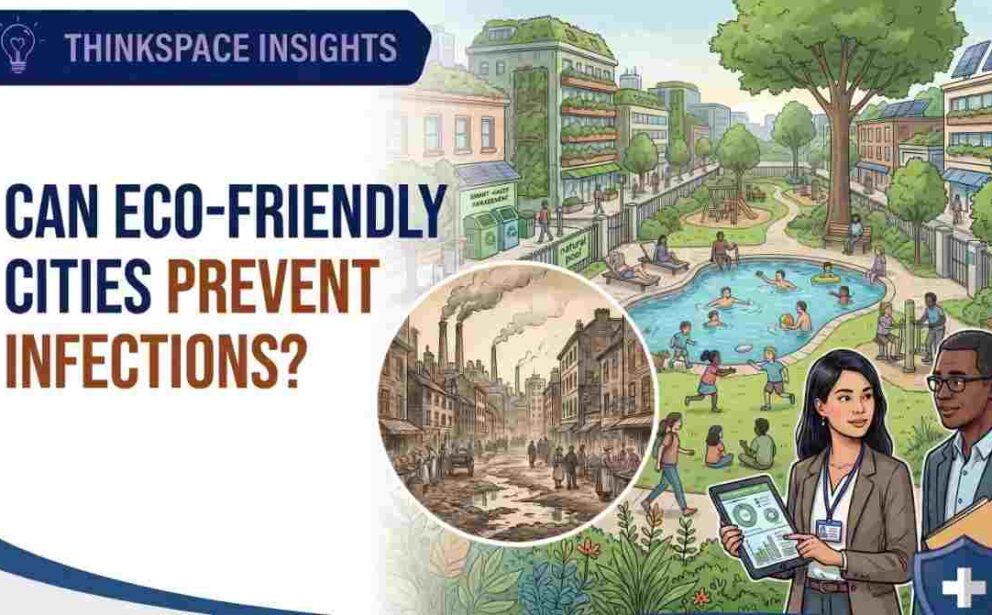
Think of a city’s sewer system like a bathtub with a slightly restricted drain. Under normal use, the water goes down perfectly fine. But if you suddenly turn on a firehose—representing a massive rainstorm—the tub violently overflows, spilling contaminated water everywhere. In urban environments, this catastrophic event is known as a combined sewer overflow (CSO). When heavy rains overwhelm a city’s drainage capacity, raw sewage and dangerous pathogens are dumped directly into rivers and lakes where people swim and play. To stop this, urban planners are turning to “blue-green infrastructure” (BGI)—utilizing natural elements like rain gardens and permeable pavements to act as a giant sponge, absorbing the storm before the tub can overflow.
These sewage overflows pose a massive and growing threat to water quality, delicate aquatic ecosystems, and human public health. When individuals are exposed to these untreated contaminants during recreational activities, it frequently leads to severe waterborne diseases. Making matters significantly worse, global climate change is currently triggering much more frequent and highly intense rainfall events. Without intervention, this shifting climate will inevitably exacerbate the number and severity of these dangerous overflows, putting urban populations at immense risk.
To determine if we can successfully engineer our way out of this looming crisis, a research team including J. Petrucci, J. Derx, and colleagues conducted an extensive environmental study. Published in Environmental Science: Water Research & Technology, the researchers investigated whether implementing blue-green infrastructure could effectively mitigate waterborne infection risks in densely urbanized waterways. They focused specifically on an Austrian urban river catchment that is heavily and frequently used by the public for swimming, wading, and playing.
The researchers utilized a highly advanced methodology that combined complex hydrologic modeling with a quantitative microbial risk assessment (QMRA). They simulated various BGI implementation strategies, analyzing the impact of converting anywhere from 0% up to 50% of the city’s impervious surfaces—like solid concrete—into permeable, water-absorbing green spaces. To ensure a comprehensive analysis, they also compared these natural implementations against a traditional “grey infrastructure” strategy, which involved simply building a massive 28,000 cubic meter artificial storage tank to hold the excess wastewater.
The models rigorously evaluated these strategies across three distinct planning horizons: a baseline period, a near-term future, and a long-term future. The results were highly encouraging, proving that blue-green infrastructure successfully reduces the probability of infection across all seasons. Crucially, the data showed that the highest protective benefits from BGI were observed during the summer months, which perfectly aligns with the peak season for recreational water use in the city.
In worst-case scenarios—such as vulnerable children accidentally swallowing river water contaminated with the Cryptosporidium pathogen—implementing 50% BGI significantly reduced the 95th percentile infection risk across all modeled future climate timelines. Ultimately, this research demonstrates that integrating natural, blue-green infrastructure into our concrete jungles is not just an aesthetic upgrade; it is a highly effective public health intervention. By allowing the city to absorb rainfall naturally, we can enhance urban resilience and secure the safety of our recreational waters against a rapidly changing climate.
ThinkSpace Insights
- The overflowing bathtub, as combined sewer overflows (CSOs) release dangerous sewage pathogens directly into urban recreational water bodies during heavy rains.
- A climate-driven crisis, noting that more frequent and intense rainfall events caused by climate change will severely exacerbate the number of these toxic overflows.
- Evaluating green solutions, with researchers combining hydrologic modeling and quantitative microbial risk assessments to test the effectiveness of blue-green infrastructure (BGI).
- Replacing the concrete, as the study simulated the protective effects of converting up to 50% of a city’s impervious surfaces into natural, water-absorbing spaces.
- Protecting summer swimmers, revealing that BGI reduces infection probabilities across all seasons, with the highest health benefits safely aligning with peak summer recreational use.
- Lowering worst-case risks, concluding that maximum BGI implementation significantly reduces the risk of Cryptosporidium infection for vulnerable populations like children swimming in urban rivers.
Access Full Article