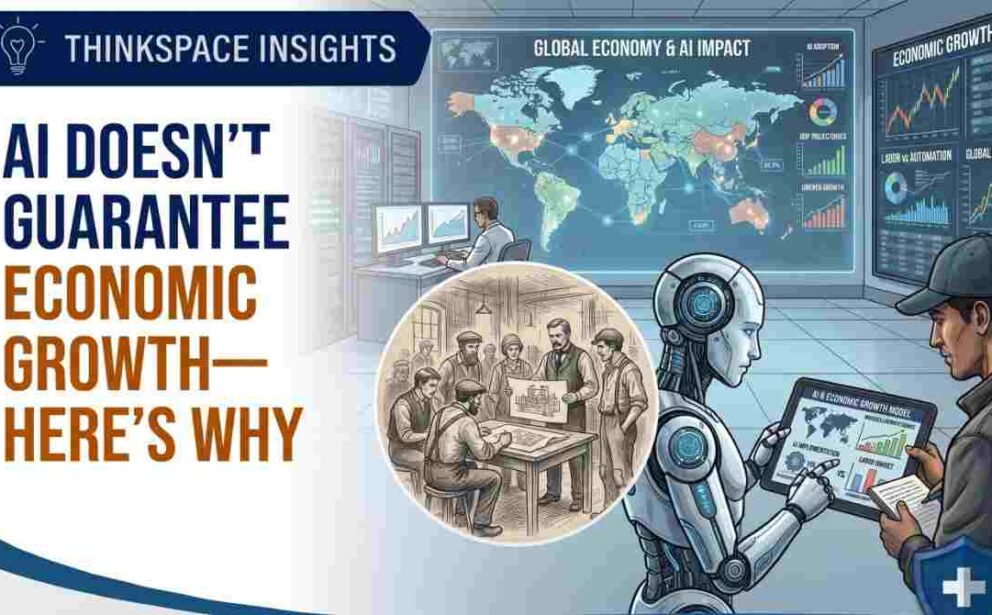
Just as steam power and electricity completely reshaped human history, artificial intelligence (AI) is now recognized as a “general-purpose technology” (GPT) due to its cross-sectoral applicability and capacity to transform multiple layers of economic activity simultaneously. However, simply inventing a new technology does not magically make a country richer or more efficient. Researchers are now looking at AI not just as a basic productivity-enhancing input, but as a complex coordination and recombination mechanism embedded deeply within a larger “innovation ecosystem”. Understanding this economic reality is crucial because throwing money at AI infrastructure without preparing the surrounding human and institutional environment can lead to surprisingly divergent structural outcomes.
Despite AI’s massive potential, the research landscape remains fragmented across different analytical traditions, meaning there is still no consensus on whether AI should be modeled primarily as a productivity shock, a driver of structural transformation, or a meta-technology reshaping knowledge production. To address this massive gap, researcher Sultan Salur Kucuk conducted a structured literature review covering the period from 2015 to 2025. The core aim of this research was to examine exactly how artificial intelligence shapes economic growth and structural transformation.
Instead of treating different economic effects as separate domains, the study adopted a mechanism-oriented synthesis approach to create a unified framework. The researcher developed an integrative innovation ecosystem framework that specifically links three core transmission channels where AI directly impacts the economy. By organizing the literature around these specific channels, the study sought to identify the exact, real-world conditions under which AI actually contributes to sustainable and inclusive economic growth.
The framework focuses on three interconnected channels: (i) total factor productivity (TFP), (ii) task reallocation and labor-market restructuring, and (iii) the acceleration of innovation and knowledge-generation dynamics. By viewing these channels as interdependent, the research clarifies why different analytical approaches often yield divergent conclusions regarding AI’s long-run impact. It proves that task transformation inherently drives broader structural changes across the labor market.
The findings reveal a crucial economic reality: AI adoption does not generate uniform or automatic growth effects. The empirical evidence remains highly heterogeneous, showing that identical AI investments frequently lead to divergent structural outcomes across different regions. In most cases, successful economic outcomes depend less on the AI technology itself and far more on complementary conditions—such as human capital formation, digital and data infrastructure, institutional coordination, and governance capacity—that enable effective technological diffusion.
Rather than predicting a rigid, deterministic growth model, the study advances a conditional, ecosystem-centered interpretation of AI-led development. The research concludes by emphasizing that “institutional complementarity” is the absolute key mechanism shaping AI-driven growth outcomes. Ultimately, this means that for society to reap the economic benefits of artificial intelligence, governments and businesses must aggressively build the human and institutional infrastructure required to support it.
ThinkSpace Insights
- A general-purpose tool, conceptualizing artificial intelligence as a general-purpose technology (GPT) capable of transforming multiple layers of economic activity across various sectors.
- No automatic benefits, revealing that AI adoption does not generate uniform or automatic growth effects, with empirical evidence remaining highly heterogeneous.
- Three channels of impact, linking AI’s economic effects through total factor productivity, labor-market restructuring, and the acceleration of knowledge production.
- Human infrastructure matters, proving that AI’s macroeconomic contribution depends heavily on complementary conditions like human capital formation and robust digital infrastructure.
- Institutions shape outcomes, emphasizing that strong institutional coordination and governance capacity are required to enable the effective diffusion of AI technologies.
- An ecosystem perspective, advancing a conditional interpretation of development that proves institutional complementarity is the key mechanism shaping AI-driven growth.
Access Full Article