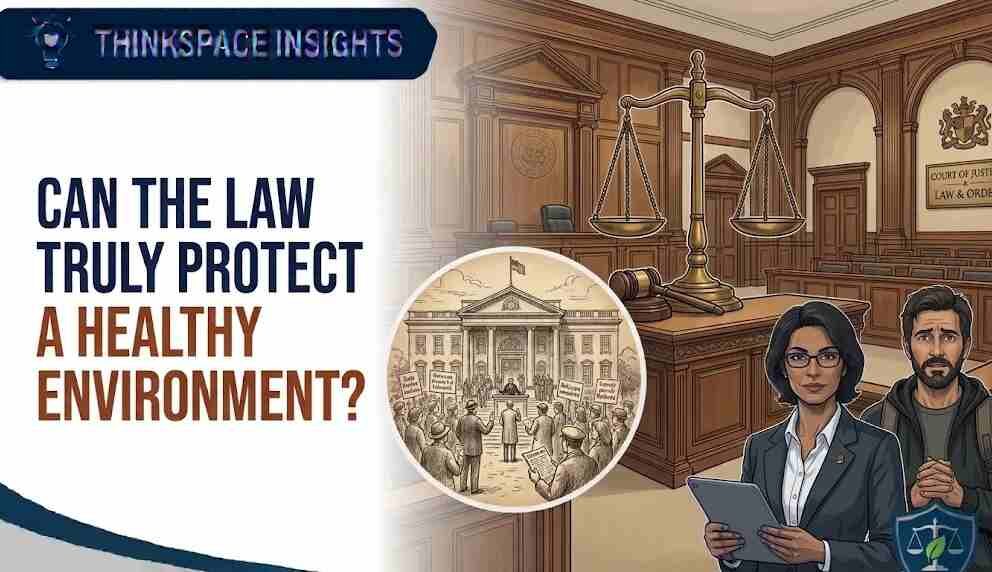
Think of a city that boasts a state-of-the-art security system on paper—complete with strict laws, alarms, and surveillance protocols—but the alarms are unplugged and the guards rarely patrol the streets. The system is conceptually perfect but practically useless against actual trespassing. This scenario closely mirrors the current state of environmental protection in Iraq and the Kurdistan Region. While advanced legal frameworks exist to protect the environment and penalize polluters, the actual enforcement on the ground remains drastically insufficient to stop ongoing ecological damage.
A healthy, clean environment is universally recognized as a fundamental “third-generation” human right, inextricably linked to the basic rights to life and physical health. To evaluate how effectively this right is safeguarded at the domestic level, researchers Tarya Nahman Saleem and Omed Safary Hasan conducted an analytical legal study. Their research focused specifically on the constitutional foundation laid by Article 33 of the Iraqi Constitution (2005), alongside the specific environmental protection and improvement laws enacted in Iraq (Law No. 27 of 2009) and the Kurdistan Region (Law No. 8 of 2008).
The researchers identified a massive operational gap between legislative intent and practical reality. The core problem is not a lack of progressive laws, but rather the severe weakness of the executive authority tasked with implementing them. Currently, the financial penalties and punishments levied against environmental violators are wildly insufficient compared to the massive scale of the ecological damage they cause. Compounding the problem is a low level of environmental legal awareness among the general public and a complete absence of specialized courts equipped to handle complex environmental crimes.
To combat this ongoing encroachment on human rights, the study presents a series of urgent legal and technological upgrades. The authors recommend significantly amending existing laws to ensure fines match the true magnitude of environmental destruction. Furthermore, they urge the government to proactively activate the public prosecutor’s role, allowing them to initiate public interest lawsuits against polluters immediately, rather than waiting for individual citizen complaints. Finally, the researchers argue that embracing modern technology—such as deploying electronic surveillance and satellite systems to monitor forests, rivers, and air quality—is absolutely essential for catching and punishing environmental offenders in the modern era.
ThinkSpace Insights
-
A fundamental human right, noting that access to a healthy, clean environment is a third-generation human right intrinsically linked to the basic rights to life and health.
-
Advanced laws, weak execution, highlighting that while Iraq and the Kurdistan Region have established constitutional and domestic environmental laws, actual executive enforcement remains severely lacking.
-
Insufficient penalties, revealing that the current fines and legal punishments do not accurately reflect the massive scale of the ecological damage being caused by violators.
-
Structural legal gaps, pointing out the critical absence of specialized environmental courts and the dangerously low level of legal awareness among the general public.
-
Empowering prosecutors, recommending that public prosecutors be given the mandate to independently initiate public interest lawsuits against polluters without waiting for citizens to file complaints.
-
High-tech surveillance, concluding that the government must deploy modern electronic surveillance and satellite tracking to effectively monitor and protect forests, rivers, and air quality from illegal encroachment.