
The Persian walnut is a highly valuable tree species, yet achieving uniform, large-scale propagation and rapid genetic improvement has traditionally been a slow and challenging process. To meet growing global agricultural demands and navigate changing climates, modern horticulture is increasingly turning to advanced biotechnological interventions. In vitro culture has emerged as a fundamental pillar to overcome these traditional constraints, providing a path toward highly uniform and scalable cultivation.
A comprehensive review by a research team including Zahra Makari Deligani, Mohammad M. Arab, and Kourosh Vahdati provides a detailed assessment of the major breakthroughs reshaping this field. Published in Planta, the study integrates decades of research to evaluate how modern laboratory protocols, genetic engineering, and digital tools are collectively transforming walnut breeding and orchard management.
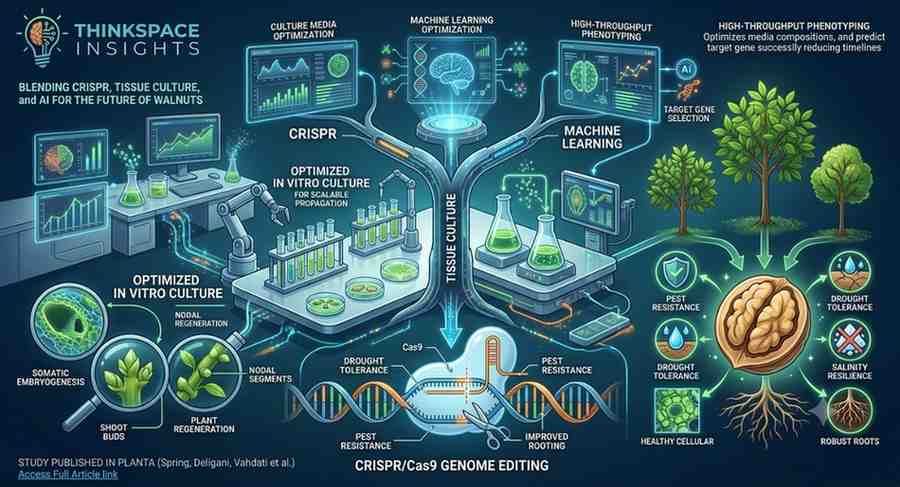
The authors detail significant advancements in optimization strategies, noting how fine-tuning culture media compositions and utilizing specific explants—such as shoot buds and nodal segments—have drastically enhanced plant adaptability and survival rates during the delicate transition to ex vitro soil environments. Furthermore, mastering somatic embryogenesis and plant regeneration has unlocked advanced breeding techniques. These include haploid production, which serves as an essential shortcut for accurate genomic mapping, mutation analysis, and the rapid development of superior hybrids.
Beyond physical tissue cultures, the review highlights a major technological shift toward precision genetics and artificial intelligence. The integration of CRISPR/Cas9 genome editing is actively accelerating the creation of elite walnut cultivars specifically engineered for better rooting abilities, superior resistance to biotic pests, and enhanced tolerance to environmental stressors like drought and soil salinity. Concurrently, the adoption of machine learning algorithms and advanced computational tools is optimizing high-throughput phenotyping, slashing experimental timelines, and significantly lowering operational research costs.
Despite these impressive milestones, the study maintains a pragmatic perspective by outlining persistent biological bottlenecks that still limit industrial-scale application. Challenges such as genotype-dependent recalcitrance, severe oxidative browning of cultures, and low transformation efficiencies continue to pose friction for researchers. The authors conclude that addressing these specific obstacles through continuously optimized culture systems and robust molecular toolsets is the non-negotiable next step to unlocking the full economic and ecological potential of Persian walnut biotechnology.
ThinkSpace Insights
- In vitro culture systems are foundational requirements for replacing traditional, highly variable breeding methods with uniform, large-scale walnut propagation.
- Advanced somatic embryogenesis serves as the core platform for high-level genomic mapping, mutation profiling, and rapid hybrid development.
- Deploying CRISPR/Cas9 allows breeders to bypass slow, conventional selection cycles to directly engineer traits like drought tolerance, salinity resilience, and superior rooting.
- The convergence of machine learning and high-throughput phenotyping dramatically reduces data collection costs and experimental timelines in tree biotechnology.
- Cellular obstacles like oxidative browning and genotype-specific recalcitrance remain the primary barriers preventing lab-scale successes from entering full commercial production.
- Future security for global walnut supply chains relies heavily on combining field-tested tissue optimization with high-precision molecular editing tools.
Access Full Article
https://link.springer.com/article/10.1007/s00425-025-04889-6