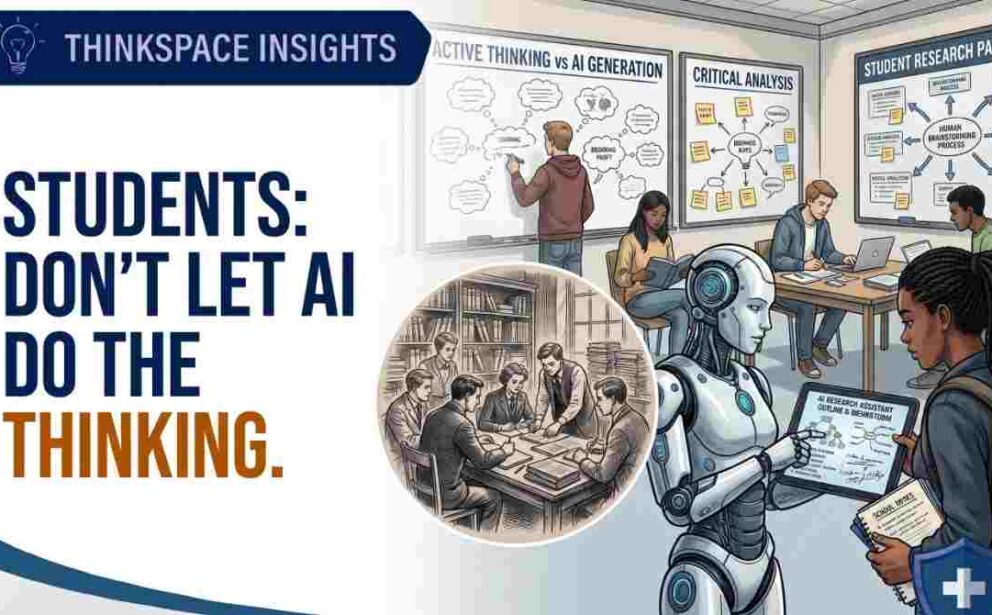
Handing a student a powerful generative AI tool is much like handing an apprentice carpenter a highly advanced power saw. In the right hands, it can drastically increase efficiency and precision, but without proper training and a clear plan, it can easily ruin the entire project. In the academic world, the sudden availability of Generative Artificial Intelligence (GenAI) has massively disrupted traditional educational paradigms, allowing the general public to instantly generate content and correct errors that previously required intense independent mastery. However, simply giving students access to these tools does not guarantee they will actually learn anything; understanding exactly how students interact with this technology is the missing blueprint for modern education.
While a growing number of publications highlight the potential of AI to enhance learning, most literature has heavily focused on the responsibilities of institutions and educators, unfortunately relegating the students’ actual experiences to the background. To bridge this critical gap, researchers Qin An, Joyce Hwee Ling Koh, and Qian Liu conducted a highly comprehensive systematic literature review. By carefully analyzing 39 peer-reviewed empirical articles published between January 2018 and June 2024, the research team aimed to pinpoint exactly how higher education students use GenAI in their daily learning tasks and how those specific uses influence their actual and perceived academic success.
The systematic review revealed a fascinatingly diverse landscape of technological interaction, outlining seven distinct ways that university students utilize GenAI for learning. These roles include using the AI as a creator, a translator, a refiner, a navigator, an evaluator, a dialoguer, and a self-regulatory supporter. Broadly speaking, the results indicated that the students’ actual learning outcomes were predominantly successful across the board. However, how the students perceived their own outcomes and the challenges they faced varied wildly depending on which of the seven roles they assigned to the AI.
The data shows that how a student treats the AI dictates their level of frustration. For instance, when students used GenAI primarily as a “creator” to generate content, they experienced an approximately equal proportion of successes and challenges regarding learning effectiveness, efficiency, and personalization. Conversely, using GenAI as a translator, refiner, navigator, evaluator, or dialoguer resulted in a much higher perceived challenge-to-success ratio. Notably, the absolute smoothest experience occurred when students utilized the technology as a “self-regulatory supporter,” which resulted in the lowest challenge-to-success ratio observed in the study.
The few challenges that did arise when using AI as a self-regulatory supporter were primarily attributed to human error, specifically a lack of integrated self-regulated learning skills and poor prompt strategy. Essentially, students struggle when they do not know how to accurately ask the AI for what they need, or when they lack the discipline to govern their own learning process alongside the machine. The results strongly suggest that for students to truly optimize GenAI for learning, they must actively strengthen these foundational self-regulation skills rather than expecting the software to do the heavy cognitive lifting for them.
To prevent this technology from becoming a crutch, the researchers outline urgent implications for educational practice and policy. Teachers and institutions must proactively address these student challenges by providing ready-to-use prompts or dedicated prompt training. Furthermore, educators must intentionally design curricula that bound the use of GenAI as a “creator,” pushing students to use it instead as a self-regulatory supporter while maintaining strict academic integrity guardrails and preserving the student’s authentic authorial voice. On a macro level, policymakers must consider these vastly different ways AI is used when allocating funding and strengthening ethical oversight mechanisms for the future of higher education.
ThinkSpace Insights
- A shift in paradigms, as the widespread availability of Generative AI allows students to easily handle content generation and error correction tasks that previously required independent mastery.
- Seven distinct roles, with the systematic review identifying that students use GenAI as a creator, translator, refiner, navigator, evaluator, dialoguer, and self-regulatory supporter.
- Actual vs. perceived success, showing that while actual learning outcomes were largely successful, students’ perceived success varied significantly depending on how they utilized the tool.
- The ideal study partner, revealing that using GenAI as a “self-regulatory supporter” resulted in the lowest challenge-to-success ratio compared to other uses.
- The human bottleneck, noting that the primary challenges students face stem from a lack of integrated self-regulated learning skills and inadequate prompt strategies.
- Institutional action required, emphasizing that educators must provide prompt training and design curricula that bound AI’s role as a creator to preserve academic integrity and the author’s voice.
Access Full Article