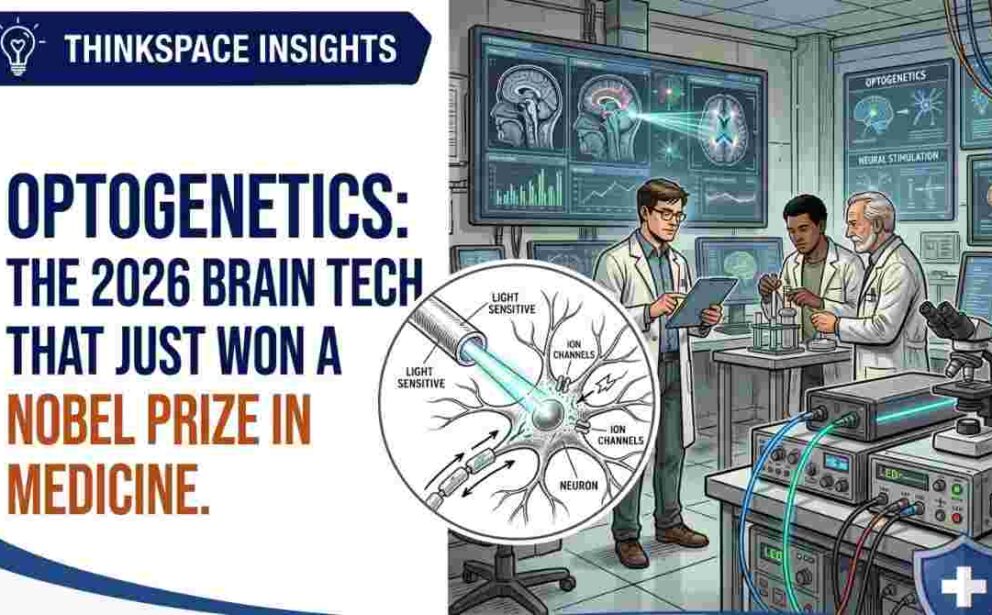
In a packed football stadium, trying to listen to one specific fan is nearly impossible over the roar of the crowd. Handing a microphone to everyone only makes the noise louder; what you actually need is a targeted switch that instantly amplifies a single voice without disturbing the rest of the spectators. For decades, neuroscientists faced this exact problem when trying to study the brain. Brain cells, known as neurons, are packed together in dense, chaotic networks, firing tiny electrical zaps called “spikes” to communicate. To isolate and control specific cells, researchers turned to an incredibly unexpected source: green algae. These simple organisms possess a natural, light-sensitive protein called Channelrhodopsin-2 (ChR2) that acts like a microscopic, solar-powered gate. By extracting the genetic code for this protein and using a harmless, hollowed-out virus as a microscopic delivery truck, scientists can insert these light-activated gates directly into specific brain cells. This breakthrough, known as optogenetics, creates a targeted switch triggered simply by a flash of blue light, giving researchers the precise control needed to finally decode the brain’s chaotic chatter.
Neural computation relies entirely on the incredibly fast, temporally diverse spiking patterns of different classes of neurons. Because specific types of neurons are sparsely embedded within dense brain tissue, deciphering the exact role of a particular neuron type in information processing has historically posed fundamental challenges. While direct electrical stimulation can trigger brain activity, it lacks the precision to target specific cell types without affecting the surrounding tissue. Previous genetically encoded optical methods existed, but they were sluggish, only allowing control over timescales of seconds to minutes. To truly probe neural coding at the resolution of single spikes, scientists needed a tool roughly a thousand times faster.
To achieve this temporally precise, noninvasive control, researchers Edward S. Boyden, Feng Zhang, and their colleagues devised a revolutionary new strategy. They looked to Chlamydomonas reinhardtii, a unicellular green alga that utilizes light-gated channels to navigate its environment. The team specifically focused on Channelrhodopsin-2, a single-component ion channel with submillisecond opening kinetics. When exposed to a flash of blue light, this protein rapidly opens a microscopic gate, allowing charged particles to rush into the cell and instantly trigger an electrical spike.
The researchers successfully adapted this naturally occurring algal protein to function within the mammalian brain. Using lentiviral gene delivery—the process of using a modified, safe virus to deliver the ChR2 genetic instructions directly into the target cells—they integrated the light-sensitive channels into mammalian neurons. The results were unprecedented. The researchers demonstrated that ChR2 could be expressed stably and safely, allowing them to use high-speed optical switching to photostimulate the neurons with absolute precision.
By activating the engineered cells with a series of brief light pulses, the team could reliably mediate defined trains of spikes and control both excitatory and inhibitory synaptic transmission with millisecond-timescale resolution. This groundbreaking technology successfully brings optical control down to the exact temporal regime occupied by the fundamental building blocks of neural computation. By allowing scientists to alter neural processing at the level of single spikes and synaptic events, this method has yielded a widely applicable, revolutionary tool for neuroscientists and biomedical engineers worldwide.
ThinkSpace Insights
- A “remote control” for the brain, as researchers successfully adapted a light-sensitive algal protein to noninvasively control specific, well-defined neuronal populations.
- Algae provides the key, utilizing Channelrhodopsin-2 (ChR2), a naturally occurring, rapidly gated cation channel found in unicellular green algae.
- Microscopic delivery systems, employing lentiviral gene delivery to safely and stably insert the light-sensitive protein’s genetic code into mammalian brain cells.
- Unprecedented speed, achieving submillisecond opening kinetics that allow researchers to trigger inward cellular currents with a simple flash of blue light.
- Precision down to the single spike, giving neuroscientists the ability to reliably mediate defined trains of electrical spikes and synaptic events on a millisecond timescale.
- A revolutionary biomedical tool, bringing optical control to the exact temporal timescale required to fundamentally understand neural networks, circuit dynamics, and behavior.
Access Full Article