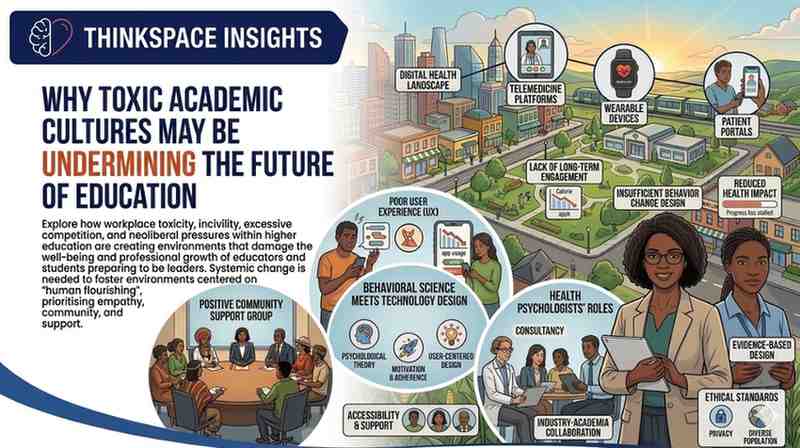


Digital health technologies are transforming healthcare delivery worldwide. From fitness trackers and wearable devices to telemedicine platforms and mobile health apps, digital tools are increasingly being used to support health monitoring, disease management, and behavior change.
However, despite the rapid growth of digital health innovation, many health applications struggle to maintain long-term user engagement. People often download health apps enthusiastically but stop using them after a short period, limiting their real-world effectiveness.
A recent chapter by Claire Hamlet in *The Palgrave Handbook of Consultancy in Health Psychology* explores how health psychologists can play a critical role in improving digital healthcare by helping design more engaging, user-centered, and scientifically grounded digital health technologies.
The chapter examines the expanding digital health landscape in the United Kingdom and highlights the growing importance of consultancy roles for health psychologists within the healthcare technology industry.
According to the research, the digital health sector has expanded rapidly in recent years, introducing technologies such as:
- Mobile health applications (mHealth apps)
- Wearable health devices
- Patient portals
- Digital behavior change interventions
Many of these technologies are designed to improve health behaviors, support self-management, and increase healthcare accessibility.
However, the chapter notes that a major challenge facing digital health products is sustaining user engagement over time.
While many apps successfully attract initial users, they often fail to provide experiences that encourage consistent long-term use and adherence. As a result, their potential health benefits are reduced.
The study argues that technological innovation alone is not enough to create effective digital healthcare systems. Understanding human behavior, motivation, habits, emotions, and user experience is equally essential.
This is where health psychologists can provide valuable expertise.
The chapter explains that health psychologists are uniquely positioned to bridge the gap between behavioral science and digital product development.
Their expertise in:
Health behavior change
Motivation and adherence
Research methodology
User-centered intervention design
Psychological theory
can help developers create digital health tools that are both scientifically credible and genuinely engaging for users.
Importantly, the chapter highlights how health psychology consultancy can strengthen collaboration between academia and industry.
Rather than remaining limited to research environments, health psychologists can increasingly contribute directly to healthcare innovation by working with technology companies, digital health startups, healthcare systems, and app developers.
The research also emphasizes the close relationship between behavioral science and user experience (UX) design. Effective digital health products must not only function technically but also feel intuitive, supportive, personalized, and accessible to diverse populations.
The chapter provides practical guidance for health psychologists interested in entering consultancy roles within digital health industries, while also discussing challenges associated with the rapidly evolving nature of healthcare technology.
Among the challenges identified are:
- Balancing scientific rigor with commercial priorities
- Designing for diverse user groups
- Maintaining ethical standards
- Protecting user privacy
- Adapting to rapidly changing technologies
The findings ultimately suggest that improving digital healthcare requires stronger integration between psychology, technology, healthcare, and user-centered design.
ThinkSpace Insights
1. Technology Alone Cannot Change Health Behaviors
Successful digital health tools must understand human motivation, habits, emotions, and engagement patterns.
3. User Experience Is Critical in Digital Healthcare
Health apps that are difficult, impersonal, or unengaging are unlikely to achieve long-term health outcomes.
4. Health Psychologists Can Improve Digital Health Innovation
Behavioral science expertise can help create more effective, evidence-based, and user-centered healthcare technologies.
5. Collaboration Between Academia and Industry Is Increasingly Important
Consultancy roles allow health psychologists to directly influence real-world healthcare innovation and digital product design.
7. Ethical and Inclusive Design Must Remain a Priority
Digital health systems should be accessible, culturally sensitive, scientifically credible, and protective of user privacy.
The chapter ultimately demonstrates that the future of digital healthcare depends not only on technological advancement but also on understanding human behavior.
As digital health tools become increasingly integrated into healthcare systems worldwide, health psychologists may play a vital role in ensuring these technologies remain effective, ethical, engaging, and truly beneficial for diverse populations.
Read More via https://lin k.springer.com/chapter/10.1007/978-3-031-91359-1_12