
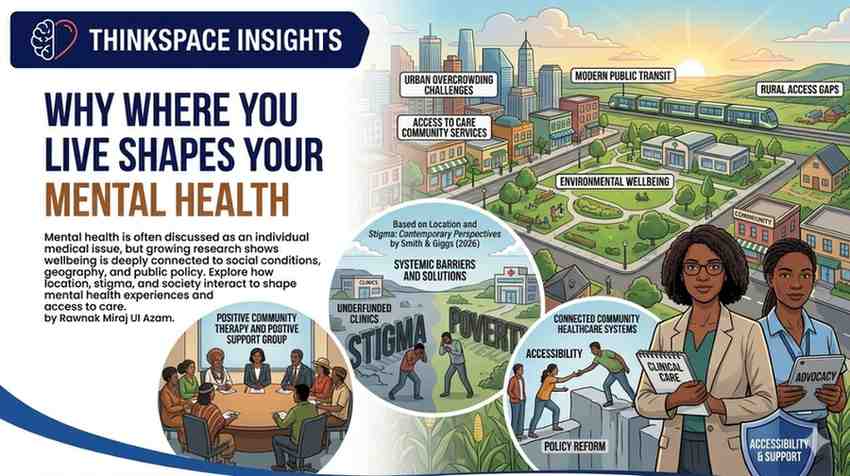
Mental health is often discussed as an individual medical issue, but growing research continues to show that mental wellbeing is deeply connected to social conditions, geography, economics, and public policy. Long before mental health became a mainstream global conversation, scholars Christopher J. Smith and John A. Giggs explored how location, stigma, and society interact to shape mental health experiences and access to care.
Their influential work, Location and Stigma: Contemporary Perspectives on Mental Health and Mental Health Care, provides a comprehensive examination of how social environments, political systems, healthcare structures, and cultural attitudes influence mental illness and mental healthcare outcomes.
Originally published in 1988 and republished by Taylor & Francis in 2026, the book remains highly relevant in today’s discussions about mental health inequality, stigma, and healthcare accessibility.
The authors argue that mental health cannot be understood solely through biological or medical explanations. Instead, mental wellbeing is shaped by the interaction of multiple social and environmental forces.
The book identifies four major factors influencing population mental health:
- Individual-level influences
- Environmental conditions
- Mental healthcare delivery systems
- Broader social, economic, and political contexts
According to the authors, these factors are deeply interconnected and collectively shape both the prevalence of mental illness and the quality of care people receive.
One of the book’s central themes is the role of stigma in mental health experiences. The researchers explain how societal attitudes toward mental illness often create additional barriers beyond the illness itself.
People experiencing mental health conditions may face discrimination, social isolation, employment challenges, housing insecurity, and reduced access to support services because of stigmatization.
The book also explores how geography and location affect mental healthcare access and outcomes. Communities with limited healthcare infrastructure, poverty, unemployment, social instability, or environmental stressors may experience higher mental health burdens while simultaneously facing fewer support resources.
Importantly, the authors emphasize that mental illness does not exist in isolation from wider social realities. Economic hardship, urban overcrowding, political instability, social inequality, and environmental stress can all contribute significantly to psychological distress.
Particularly notable is the book’s focus on how healthcare systems themselves influence mental health outcomes. The structure, accessibility, and organization of mental health services can determine whether individuals receive effective treatment or remain underserved.
The book also compares mental health policies in the United Kingdom and United States, highlighting how political and healthcare systems shape mental health governance differently across countries.
Another major contribution of the work is its historical perspective. The authors situate mental health treatment within broader cultural and political contexts, showing how societal attitudes toward mental illness evolve over time.
Although first published decades ago, many issues discussed in the book remain highly relevant today:
Mental health stigma persists globally
Access to care remains unequal
Social determinants continue to shape mental wellbeing
Economic inequality influences mental health outcomes
Healthcare systems still struggle to meet growing mental health demands
The work ultimately demonstrates that improving mental health outcomes requires more than clinical treatment alone. It also requires addressing broader social, economic, and environmental inequalities.
ThinkSpace Insights
1. Mental Health Is Deeply Connected to Social Conditions
Mental wellbeing is influenced not only by individual biology but also by poverty, inequality, housing, employment, and social environments.
2. Stigma Remains a Major Barrier to Care
Discrimination and negative societal attitudes continue to prevent many individuals from seeking or receiving mental healthcare support.
3. Geography Influences Mental Health Outcomes
Where people live can shape both exposure to mental health stressors and access to quality mental healthcare services.
4. Mental Healthcare Systems Need Structural Reform
Accessible, equitable, and community-centered mental healthcare systems are essential for improving public mental health outcomes.
5. Public Policy Plays a Critical Role in Mental Wellbeing
Political decisions involving healthcare funding, housing, social protection, and economic development can significantly affect population mental health.
The book ultimately reminds us that mental health is not simply a personal issue — it is also a social, economic, political, and environmental issue.
As societies continue to confront rising mental health challenges worldwide, understanding the relationship between location, stigma, inequality, and healthcare systems remains essential for building more compassionate and effective mental health policies.