
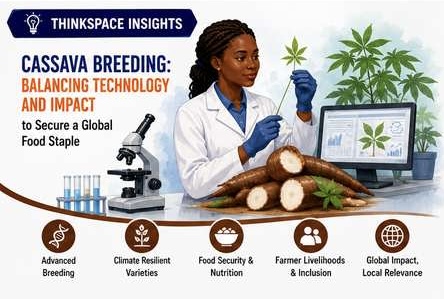
Cassava is an extraordinarily resilient crop with immense geopolitical and economic significance. Across the African continent, it serves as a critical frontline staple ensuring food security for hundreds of millions, while in Southeast Asia, it functions as a highly competitive raw source for industrial starch production. Because both the roots and leaves of the plant are utilized across diverse markets, breeding programs must navigate a wide, complex matrix of evolutionary goals.
Developing cassava varieties tailored for industrial starch and animal feed is relatively straightforward, relying on a few clearly defined traits. Conversely, cultivating varieties for direct human ethnic consumption involves a complex array of root quality characteristics that remain poorly understood by scientists. A comprehensive review by researchers Hernán Ceballos and Sean Fenstemaker explores these dynamics, tracing how a surge of investment over the last three decades has reshaped the agricultural landscape of this vital crop.
Despite the rapid integration of cutting-edge biotechnologies into modern breeding programs, significant knowledge gaps continue to persist. The lack of standardized, practical protocols has severely bottlenecked the full potential of these advanced technologies. Consequently, research progress in cassava has been notoriously uneven; while genetic transformation and the crop’s first molecular map were successfully achieved way back in the 1990s, a fundamental breeding protocol like proper flowering control was not widely adopted until 2020.
Furthermore, cassava presents a unique biological hurdle that sets it apart from many other major global crops. Its breeding relies heavily on highly heterozygous progenitors. This genetic complexity has considerably slowed down and hindered the real-world impact of marker-assisted and genomic selections, preventing breeders from predicting crop traits with the same ease seen in other domesticated plants.
To unlock the true potential of the crop, the authors emphasize that the global scientific community must pivot its approach. True progress will rely on the seamless integration of conventional agronomic wisdom with advanced molecular technologies. Most importantly, the study highlights a pressing need for funding bodies to prioritize impact-driven investments—focusing on practical, real-world outcomes for farmers—rather than purely technology-driven research that chases novelty over utility.
ThinkSpace Insights
Search Full Article: https://doi.org/10.1016/j.tas.2025.100002