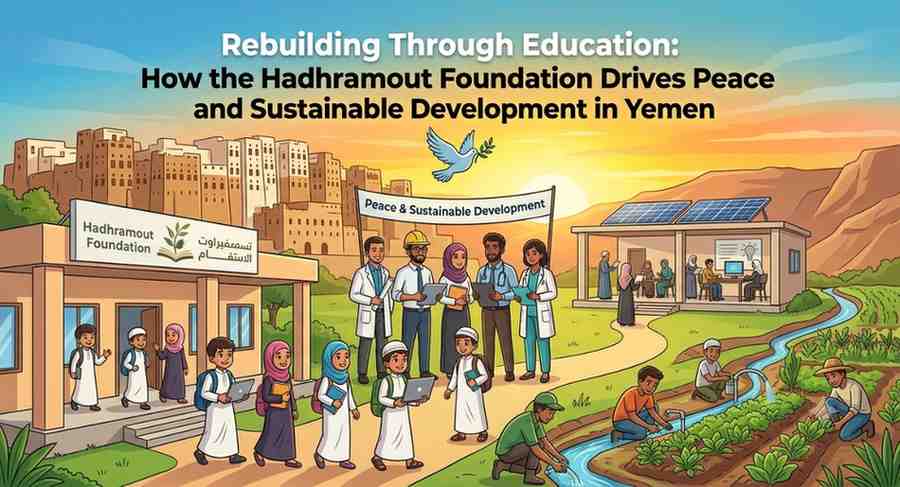
In regions destabilized by prolonged conflict and state fragility, the collapse of civic infrastructure often leaves severe, generational gaps in education. In Yemen, the ongoing crisis has deeply fractured the academic landscape, cutting off pathways to both economic stability and social cohesion. In these highly volatile environments, integrating peace education with sustainable development initiatives is not merely an academic exercise—it is a critical survival mechanism for rebuilding communities from the ground up.
A compelling study by researcher Hamad Edhah Yaslam Aldhlea, published in In Factis Pax, highlights a powerful counter-narrative to this instability by examining the prominent role of the Hadhramout Foundation – Human Development (HFHD). The research investigates how this vital organization steps in to fill the structural voids left by the state, utilizing a targeted blend of local and international scholarships, practical technical and vocational training, and comprehensive youth empowerment programs.
The study details how HFHD operates beyond traditional philanthropy by actively integrating peace pedagogy directly into its educational initiatives. Rather than treating workforce development and civic engagement as separate goals, the Foundation intertwines them. By equipping young Yemenis with both the technical skills required to rebuild their local economies and the civic frameworks needed to foster social harmony, the program creates a resilient, forward-looking generation capable of navigating and mitigating conflict.
While the Foundation’s work provides immense hope, the research does not shy away from the stark realities of operating in a war zone. HFHD consistently battles severe funding constraints, limited international partnerships, and the unpredictable daily disruptions caused by Yemen’s broader instability. Nevertheless, Aldhlea concludes that the Foundation successfully provides a highly replicable, community-driven development model for other conflict-affected settings, ultimately proving that structured education remains one of the most powerful, transformative tools for securing sustainable peace.
ThinkSpace Insights
- Education functions as a dual-purpose mechanism in conflict zones, simultaneously serving as an engine for economic survival and a foundational tool for active peacebuilding.
- The Hadhramout Foundation – Human Development (HFHD) effectively bridges state-level structural gaps, using scholarships and vocational training to bypass the paralysis of state fragility.
- Integrating peace pedagogy into technical training is crucial, ensuring that workforce development also cultivates civic responsibility and social cohesion.
- Youth empowerment programs act as a stabilizing anchor, providing vulnerable demographics with actionable pathways away from conflict and toward sustainable local development.
- Operating in high-conflict environments requires massive institutional resilience, as organizations must constantly navigate severe funding deficits and unpredictable geopolitical instability.
- Community-driven development models provide a globally replicable blueprint, demonstrating how localized educational interventions can thrive even when national infrastructures collapse.
Access Full Article
https://openjournals.utoledo.edu/index.php/infactispax/article/view/1885