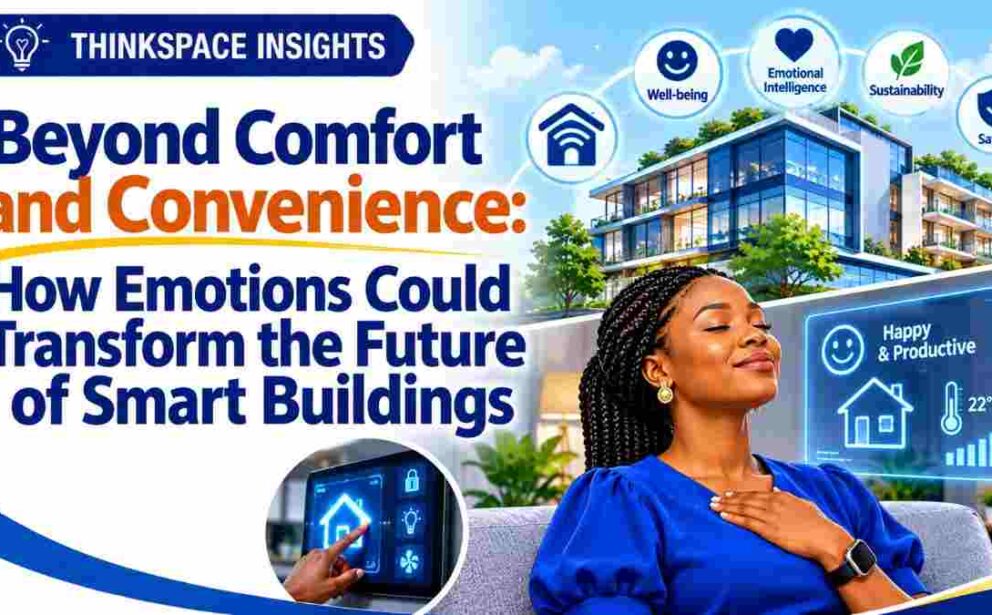
As technology becomes increasingly integrated into modern architecture, smart buildings are being designed to improve comfort, efficiency, and user experience. However, human experiences within buildings go beyond measurable conditions such as temperature, lighting, air quality, and noise. They are also shaped by emotions, personal experiences, social interactions, and the meanings people attach to their surroundings.
A 2026 research paper by Shruti Rao, Judith Good, and Hamed Alavi, presented at the Proceedings of the 2026 CHI Conference on Human Factors in Computing Systems, explores how emotions and affective interaction can influence the design and development of smart buildings.
The researchers argue that current smart building systems largely prioritise measurable dimensions of human comfort, including thermal, respiratory, visual, and acoustic conditions. While these features are important, they do not fully capture how people experience and interpret the spaces they inhabit.
This creates a gap between what building technologies can sense and regulate and the more complex, subjective, and socially influenced ways people experience their environments.
To address this gap, the study introduces Affective Interaction (AfI) as a perspective for connecting interaction design research with architectural practice. Rather than viewing occupants simply as users whose comfort needs to be measured and controlled, this approach considers them as individuals whose emotions, experiences, and social interpretations influence how they interact with smart environments.
The researchers illustrate this perspective through two exploratory studies using open-ended, in-situ research methods. These approaches allowed them to examine how people experience smart environments in their everyday settings.
The findings reveal five ways occupants interpret smart environments, including how they read bodily cues, anticipate possible disruptions, and make sense of automated building systems.
Building on these findings, the researchers identify six Affective Practices and six Interaction Qualities that can guide future interaction design research in architecture.
These insights suggest that smart buildings should not only respond to measurable environmental conditions but should also account for the emotional and social dimensions of human experiences.
Ultimately, the study calls for a broader understanding of smart architecture, one that moves beyond automation and physical comfort to consider how buildings can support meaningful, responsive, and emotionally aware interactions with their occupants.
ThinkSpace Insights
Beyond measurable comfort, highlighting the limitations of smart building systems that focus mainly on temperature, air quality, lighting, and sound. Human experiences within buildings are also shaped by emotions, personal circumstances, and social interactions.
The emotional side of smart architecture, exploring how Affective Interaction (AfI) can help bridge the gap between what building technologies can measure and the complex ways people experience their surroundings.
Understanding how occupants interpret smart environments, revealing five ways people make sense of smart buildings, from recognising bodily cues and anticipating disruptions to interpreting automated building responses.
From automation to meaningful interaction, emphasising that smart buildings should not simply adjust environmental conditions automatically. Their design should also consider how occupants understand, experience, and respond to these technological interactions.
Six Affective Practices and six Interaction Qualities, drawing attention to the study’s proposed design insights, which provide a foundation for future research into emotionally responsive interactions between people and built environments.
Architecture must consider lived experiences, highlighting the importance of understanding buildings as more than physical structures. They are spaces where people develop relationships, experience emotions, interact socially, and create personal meanings.
Rethinking the future of smart buildings, concluding that effective smart architecture should combine technological intelligence with sensitivity to human emotions, experiences, and social contexts.
The future of smart buildings should not be measured only by how efficiently they regulate temperature, lighting, or air quality. It should also consider how people feel, interact, and experience the spaces they occupy.
By bringing emotional awareness into architectural and interaction design research, smart buildings could move beyond providing physical comfort towards creating environments that respond more meaningfully to human experiences.
Access Full Article: https://dl.acm.org/doi/full/10.1145/3772318.3791739