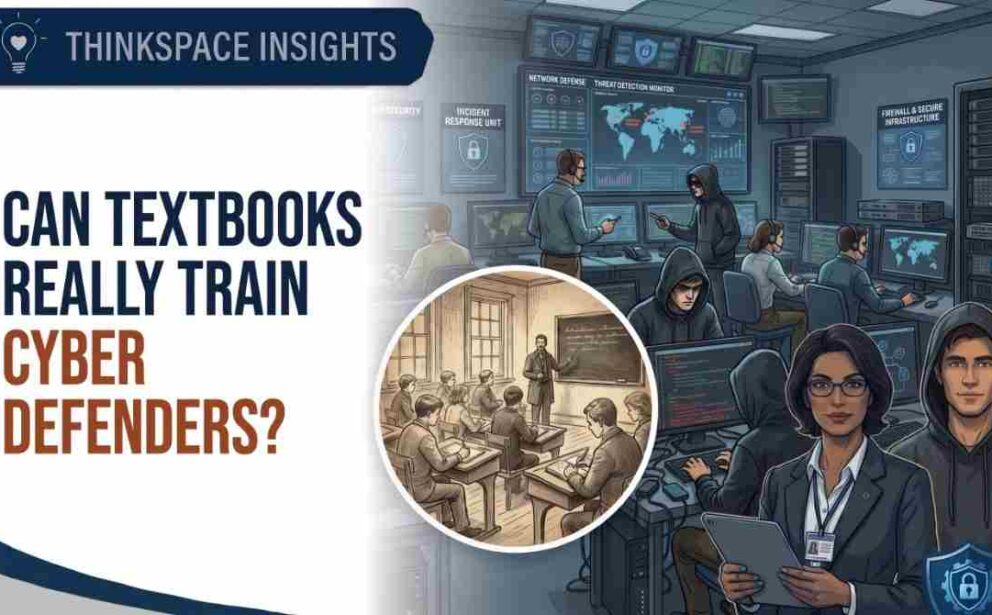
Think of training a firefighter by only having them read manuals and press buttons in a perfectly predictable, risk-free simulator. When a real, chaotic fire breaks out, they will struggle to adapt to the unpredictable environment. In the realm of cybersecurity education, a very similar instructional gap exists. As attacks on endpoints become increasingly frequent and sophisticated, traditional lecture-based methods and preconfigured “hand-holding” lab environments often fail to equip students with the applied skills needed to detect and respond to live threats. While step-by-step commercial training platforms help students complete technical tasks, they frequently do so at the expense of developing critical problem-solving skills and a deep understanding of complex, interconnected security incidents.
To bridge this massive gap between the classroom and the server room, a research team from Grand Valley State University developed a comprehensive project-based educational framework. Published in the 2026 Journal of The Colloquium for Information Systems Security Education, the paper details how educators can move away from predetermined, isolated labs by integrating real-world enterprise software—specifically the open-source endpoint protection platform Wazuh—directly into the curriculum.
Instead of merely following a script to execute given commands, students utilizing this framework are plunged into realistic endpoint and network security scenarios. They are required to actively install and configure the Wazuh agents, monitor and interpret live system and application logs, and detect active, simulated security incidents such as brute-force attacks and malware executions. By applying industry-aligned procedures to these messy, real-world data streams, students learn to navigate the actual operational security roles they will face upon graduation.
The educational results strongly validate this hands-on approach. The researchers’ evaluation of student performance demonstrated substantial improvements in practical technical skills, specifically regarding alert interpretation, rule configuration, and the dynamic application of cybersecurity knowledge. Ultimately, the study confirms that integrating actual enterprise security tools into academic coursework effectively develops both technical proficiency and analytical thinking, successfully aligning student capabilities with rigorous national workforce competency standards like NIST NICE.
ThinkSpace Insights
- The training gap, noting that traditional lectures and step-by-step, preconfigured lab environments fail to teach the problem-solving and critical thinking required for real-world cyber incidents.
- A project-based framework, highlighting a new educational model that integrates Wazuh, a real-world enterprise security tool, directly into the academic curriculum.
- Real-world scenarios, explaining that students engage in realistic tasks like deploying software, interpreting live application logs, and detecting simulated brute-force attacks.
- Beyond hand-holding, emphasizing that the approach forces students to develop a deep understanding of complex, interconnected security concepts rather than just executing given commands.
- Measurable improvement, revealing that the framework resulted in substantial student improvements in practical technical skills, alert interpretation, and rule configuration.
- Workforce alignment, concluding that this experiential learning model successfully aligns academic training with the operational requirements of national standards like NIST NICE.
Access Full Article
https://journal.cisse.info/index.php/jcisse/article/download/244/244/480