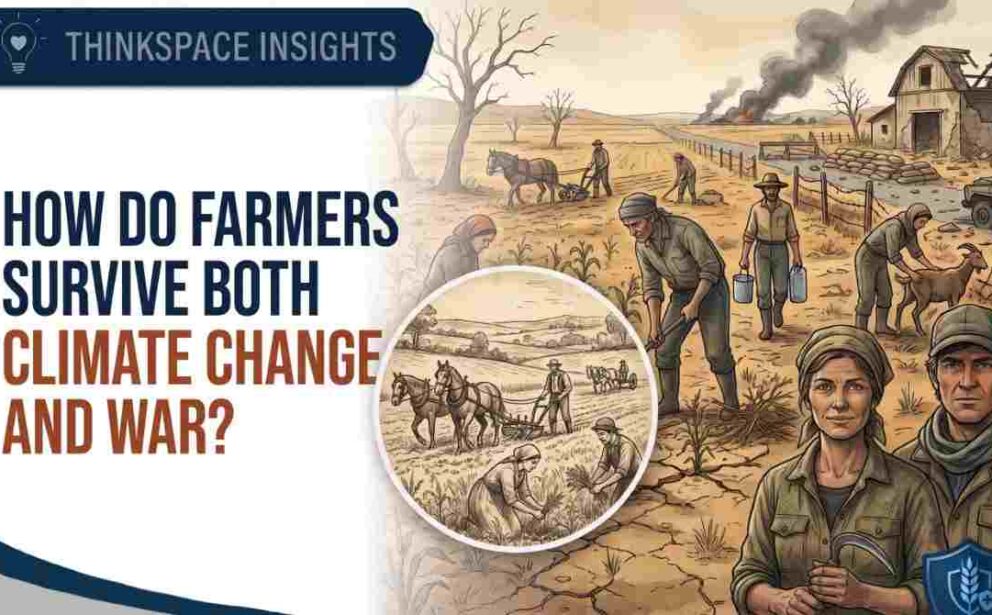
Think of trying to patch a severely leaking roof during a hurricane, only to discover that the foundation of your house is simultaneously collapsing. Dealing with one catastrophic problem is incredibly difficult, but when multiple destructive forces interact and compound, standard repair manuals become completely useless. For millions of smallholder farmers across the Global South, this is the daily reality of the “climate-conflict nexus.” These vulnerable populations are forced to adapt to extreme weather, droughts, and unpredictable climate variability while simultaneously navigating the devastating, destabilizing impacts of ongoing wars, civil unrest, and local resource disputes.
While the scientific community has spent considerable time debating the causal pathways between these two forces—such as how climate-induced resource scarcity triggers violence, or how war degrades the environment—far less attention has been paid to the people caught in the middle. Smallholder farmers face a complex web of interwoven social, economic, and environmental vulnerabilities. Because conflict fundamentally lowers a society’s capacity to adapt, generalized climate policies often fail completely in these highly unstable settings.
To bridge this massive gap in agricultural and development research, a team led by Damasco Rubangakene conducted a comprehensive systematic review. Published in Frontiers in Climate, the study aimed to consolidate fragmented empirical evidence regarding how smallholder farmers actually adapt to climate change within conflict-affected areas. Following strict PRISMA 2020 guidelines, the researchers analyzed peer-reviewed empirical literature published between 2004 and 2024, focusing heavily on the Global South where these compounding crises are most acute.
Crucially, the researchers broadened the scope of their review beyond just formal “armed” warfare. They recognized that smallholder farmers are heavily impacted by a wide spectrum of hostilities, including local land disputes, ethnic and religious tensions, and political violence. Each of these distinct forms of conflict interacts differently with a community’s adaptive capacity, actively shaping how farmers attempt to build resilience.
The systematic synthesis identified eleven integrated adaptation strategies currently utilized by farmers in these extreme environments. However, it also exposed glaring deficiencies in how the academic and policy communities understand these survival tactics. The review revealed that a staggering 67% of the analyzed studies failed to connect specific adaptive capacities to specific vulnerabilities. Even more concerning, one-third of the literature completely ignored how adaptation is dictated by local power relations and social hierarchies, treating communities as uniform entities rather than highly stratified groups where marginalized individuals face much steeper barriers to survival.
Ultimately, the study underscores that addressing the climate-conflict nexus requires moving beyond generic agricultural solutions. The researchers emphasize that development agencies, local governments, and NGOs must design highly context-specific, socially conscious policies. By truly understanding the overlapping vulnerabilities that smallholder farmers face, global institutions can finally implement integrated interventions that meaningfully strengthen resilience, reduce vulnerability, and protect sustainable livelihoods in the world’s most volatile regions.
ThinkSpace Insights
-
The double burden: Smallholder farmers in conflict zones face a compounded crisis, forced to adapt to severe climate change while simultaneously navigating the destabilizing effects of ongoing violence.
-
A research blind spot: While many studies explore how climate change triggers conflict, very little research has focused on the actual adaptive responses of the farmers experiencing these intersecting threats.
-
Broadening the scope: Effective resilience research must look beyond formal armed warfare to include how local land disputes, ethnic tensions, and political violence hinder agricultural adaptation.
-
Missing connections: The systematic review revealed that 67% of current studies fail to adequately link a farmer’s specific adaptive capacities to their specific environmental and economic vulnerabilities.
-
Ignoring power dynamics: One-third of the reviewed literature completely overlooked how local power relations and rigid social hierarchies dictate who gets to successfully adapt and who is left behind.
-
Context is critical: Development agencies and policymakers must abandon generalized climate strategies in favor of highly targeted, conflict-sensitive interventions tailored to the specific realities of the Global South.