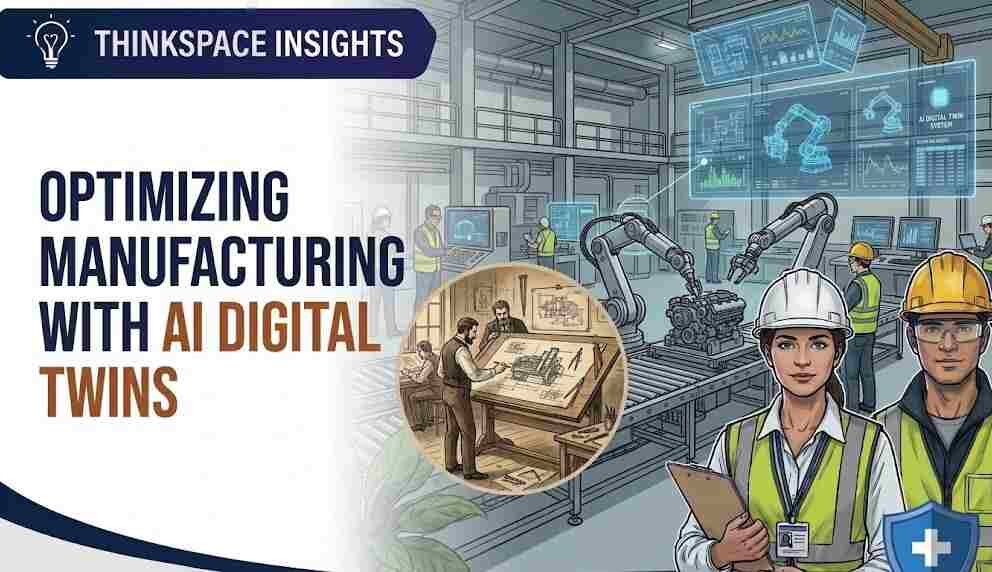
Think of how a modern software engineer uses a sandbox environment to safely test complex new code before pushing it to a live user interface. If the code breaks, the live application remains perfectly intact. In the world of industrial production, systems engineers are now building these exact same “sandboxes” for entire physical factories. These environments are known as “digital twins”—continuously coupled, virtual replicas of physical manufacturing systems. Driven by artificial intelligence, these digital twins have evolved from static 3D simulations into adaptive, learning-enabled systems embedded directly within cyber-physical environments. They allow engineers to predict equipment failures, optimize production workflows, and test energy efficiencies without ever risking the real-world factory floor.
This technological leap arrives at a critical moment, as the manufacturing sector faces unprecedented global pressure to drastically increase productivity while simultaneously slashing energy consumption, material waste, and carbon emissions. However, a severe disconnect currently exists between corporate ambitions and operational reality. Evidence from industrial surveys indicates that while 73% of manufacturers have established strict net-zero targets by 2050, a dismal 10% actually possess the digital infrastructure required to track and optimize those emissions in real time. Furthermore, a recent 2024 survey of 150 manufacturing firms revealed that 88% still rely primarily on manual, spreadsheet-based energy tracking, suffering from average reporting delays of four to six weeks.
To address this massive operational gap, researcher Francis T. Omigbodun conducted a critical review exploring how AI-driven digital twins can actively push manufacturing toward true sustainability. By meticulously analyzing 291 peer-reviewed studies published between 2015 and 2024, the comprehensive review aimed to explicitly articulate the complex relationship between AI capabilities, digital twin architectures, and environmental outcomes. Rather than viewing these digital models as mere technical optimization tools, the research fundamentally reframes digital twins as crucial decision-making infrastructures. Their true value relies entirely on how effectively they integrate sustainability metrics—like carbon intensity and material efficiency—into real-time control and long-term industrial planning.
The core mechanism driving this transformation is the development of hybrid AI-physics architectures. Traditional offline simulations simply cannot handle the non-linear dynamics and operational uncertainty of modern production systems. By combining rigorous physics-based models with data-driven machine learning, these advanced digital twins successfully balance predictive performance with physical consistency and explainability. This allows the AI to actively learn from live operational data, instantly update its models, and seamlessly interact with physical assets to govern energy-aware optimization and predictive maintenance on the fly.
Despite this incredible potential, the review exposes several critical challenges and structural barriers currently hindering large-scale industrial adoption. The researcher identifies severe data interoperability fragmentation and platform lock-in as major technical hurdles preventing seamless integration. Furthermore, human factors such as intense organizational resistance, regulatory ambiguity surrounding AI-driven decisions, and ongoing issues with algorithmic trust continue to slow progress. Consequently, the study notes that most current digital twin implementations remain highly conservative, stuck in the “monitoring-prediction” phase and falling far short of fully integrated, sustainability-governed control.
Overcoming these structural barriers is vital, as the digital twin market in manufacturing is currently growing at 31% annually and is projected to reach an astronomical $73 billion by 2030. As the technology scales, the research emphasizes the urgent need for digital twins that can accurately reason across various timescales, operational objectives, and lifecycle boundaries. By successfully aligning advanced manufacturing intelligence with measurable sustainability outcomes, AI-enabled digital twins can finally move industries past incremental efficiency gains and deliver a transformative impact on net-zero and circular manufacturing systems.
ThinkSpace Insights
-
The virtual factory, as digital twins act as continuously coupled, AI-driven virtual replicas of physical manufacturing systems.
-
A massive data gap, noting that while 73% of manufacturers have net-zero targets for 2050, only 10% possess the digital infrastructure for real-time emission tracking.
-
Outdated tracking methodologies, revealing that 88% of surveyed manufacturing firms still rely on spreadsheet-based energy tracking with delays of up to six weeks.
-
Hybrid intelligence, highlighting that modern digital twins utilize hybrid AI-physics architectures to actively govern energy consumption, predictive maintenance, and material efficiency.
-
Structural bottlenecks, pointing out that large-scale industrial adoption is currently hindered by data fragmentation, platform lock-in, and organizational resistance.
-
A booming market, projecting the manufacturing digital twin sector to reach $73 billion by 2030 as the industry pushes toward transformative circular and net-zero production.