
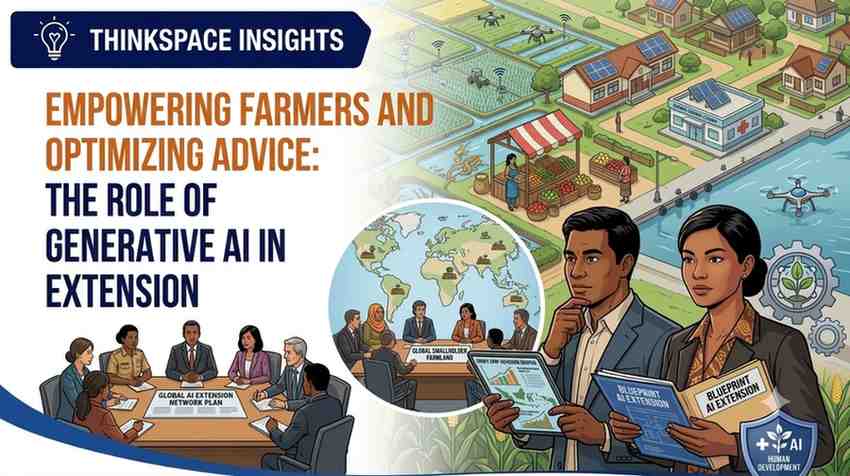
Small and marginal farmers around the world face a complex web of intersecting challenges, from severe food insecurity and climate-driven environmental risks to systemic structural disadvantages. Historically, agricultural extension—the application of scientific research and new knowledge to agricultural practices—has played a central role in supporting these communities. Over time, these advisory approaches have evolved, shifting away from rigid top-down models to prioritize participatory learning, farmer agency, and ethical knowledge exchange.
As artificial intelligence begins to rapidly penetrate the agricultural advisory landscape, its true potential to support smallholder learning has become a subject of intense interest and debate. A compelling study by researchers Chris High, Namita Singh, and Gusztáv Nemes explores this vital intersection. To assess whether modern AI applications align with ethical and participatory extension goals, the authors propose a novel typology of learning based on two critical dimensions: the locus of knowledge production and the orientation of agricultural knowledge and innovation systems (AKIS).
The study grounds its analysis in a detailed, real-world case study of Farmer.Chat, a generative AI-powered advisory tool developed through a collaboration between Digital Green and Microsoft Research. Deployed across four countries, the platform was designed to deliver real-time, personalized agricultural advice directly to smallholders.
Using mixed-methods data, the researchers examined exactly how this AI tool supports or limits different types of learning, trust-building, and knowledge co-creation. The findings revealed a nuanced, dual reality. On one hand, Farmer.Chat significantly enhances information access, offering highly scalable and personalized advisory services to farmers who might otherwise be cut off from traditional extension networks. On the other hand, the data shows that the tool still heavily leans toward individualized, one-way communication, falling short of true collaborative learning.
Ultimately, the study concludes that technology alone cannot transform smallholder agriculture. The full potential of tools like Farmer.Chat depends entirely on embedding them within trusted, existing social infrastructures. By enabling dynamic feedback loops and aligning with “double-loop” learning and participatory ethics, developers can prevent AI from becoming a mere megaphone. Instead, it can become a cooperative mechanism that supports more inclusive, adaptive, and democratic agricultural knowledge systems worldwide.
ThinkSpace Insights
- Agricultural extension must continuously evolve, ensuring that emerging AI applications protect farmer agency and ethical, participatory knowledge exchange.
- Generative AI tools like Farmer.Chat represent a massive leap forward in democratizing information, providing scalable, personalized advisory services to remote smallholders.
- Despite their advanced capabilities, current AI systems risk reinforcing old, individualized, one-way communication models rather than fostering true knowledge co-creation.
- The success of digital agricultural tools relies heavily on embedding the technology into trusted, pre-existing local social infrastructures and community networks.
- To achieve transformative “double-loop” learning, agricultural AI must implement robust feedback loops that allow the system to learn from the farmers’ real-world experiences.
- Designers and policymakers must actively pursue an intentional research agenda to ensure AI tools support inclusive, adaptive, and deeply democratic innovation ecosystems.
Access Full Article
https://journals.sagepub.com/doi/full/10.1177/24551333251345224