
Maize stands as an absolutely critical crop for meeting the nutritional demands of a surging global population, yet its agricultural production chain faces severe structural inefficiencies that frequently undermine its economic viability. In regions like central-south Angola, where maize is a baseline staple, understanding the localized bottlenecks that smallholders navigate is an absolute necessity for designing targeted, impactful interventions.
A comprehensive, mixed-methods study by researchers Hélder de Castro José Abel, Eládio Zacarias Mendes Fina, and Israel Freitas Nongando Domingos dives directly into this agricultural landscape. Published in early 2026, the research leverages semi-structured surveys and in-person interviews with local farmers, parsing the raw data through a strategic SWOT (Strengths, Weaknesses, Opportunities, and Threats) matrix to evaluate how these constraints ripple across the regional supply chain.
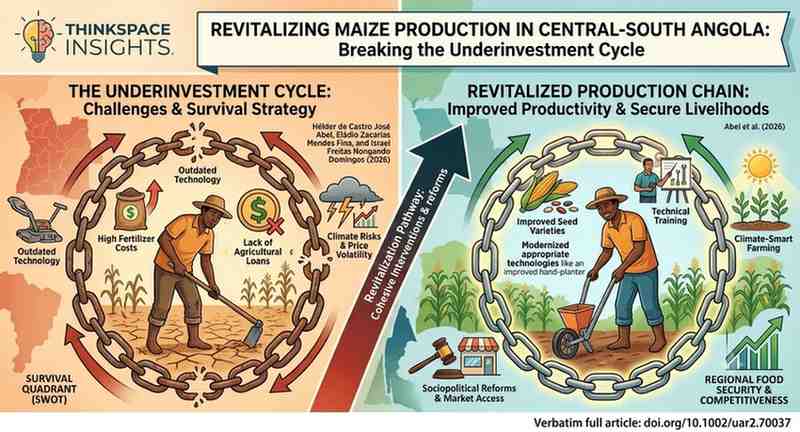
The findings reveal a clear hierarchy of hardship. Smallholders overwhelmingly perceive technical constraints as their most pressing day-to-day bottleneck, closely followed by sharp financial challenges—specifically the soaring costs of fertilizer acquisition and a systemic lack of access to agricultural loans. This creates a painful paradox: despite a massive national demand and a deep-rooted, rich tradition of maize cultivation, the entire sector remains severely bottlenecked by outdated, manual technologies among smallholder communities.
According to the study’s SWOT analysis, structural weaknesses heavily outweigh external threats, signaling that the sector is currently operating in a “survival” quadrant. While massive opportunities exist—such as the distribution of high-yield, climate-smart maize varieties and broader market expansion—they are continuously stifled by immediate threats like severe price volatility and unpredictable climate risks.
Ultimately, the authors emphasize that breaking the historical cycle of underinvestment among small-scale farmers requires moving past passive assistance. To boost agricultural productivity, secure local livelihoods, and elevate regional competitiveness, state and NGO interventions must execute a synchronized strategy: delivering direct access to improved seed varieties, providing hands-on technical training, and enacting robust sociopolitical reforms that protect smallholders from volatile market shocks.
ThinkSpace Insights
- Maize remains a foundational pillar for regional food security, but its economic potential cannot be unlocked without aggressively addressing smallholder operational bottlenecks.
- Technical and financial barriers—specifically high fertilizer costs and a lack of formal credit lines—create an aggressive chokehold that restricts crop yields.
- A severe developmental gap persists where high domestic market demand is systematically undermined by outdated, low-tech farming methodologies.
- The predominance of internal organizational weaknesses over external threats forces agricultural managers to prioritize immediate “survival strategies” over aggressive expansion.
- Unpredictable climate risks and high market price volatility function as compounding threats that actively discourage smallholders from investing in their own farms.
- Transforming the maize value chain relies on executing cohesive sociopolitical reforms, pairing technical training with direct access to modernized agricultural inputs.
Access Full Article