
Quantum computing is rapidly emerging as one of the most transformative technologies of the 21st century. Unlike conventional computers that process information using binary bits, quantum computers leverage the principles of quantum mechanics to perform complex computations at unprecedented speeds. While large-scale quantum machines are still under development, ongoing advances in quantum technology are already reshaping scientific research, industry innovation, and long-term technological planning.
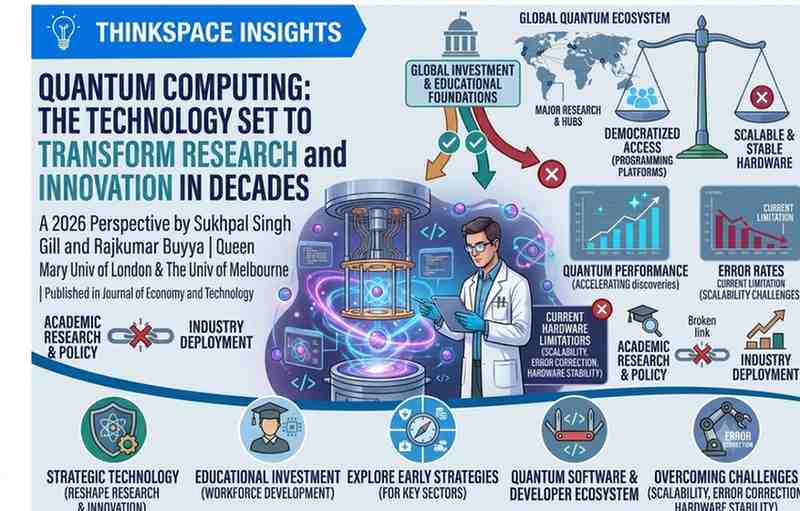
A 2026 perspective article by Sukhpal Singh Gill and Rajkumar Buyya explores the current state of quantum computing and its potential to revolutionize research and society. Gill is affiliated with the School of Electronic Engineering and Computer Science, Queen Mary University of London, United Kingdom, while Buyya is affiliated with the Cloud Computing and Distributed Systems (CLOUDS) Laboratory, School of Computing and Information Systems, The University of Melbourne, Australia. The article was published in the Journal of Economy and Technology and examines emerging opportunities, applications, software ecosystems, and future research directions in quantum computing.
The authors highlight that quantum computing derives its power from quantum phenomena such as superposition and entanglement. These capabilities enable quantum systems to process vast numbers of possibilities simultaneously, making them particularly valuable for solving highly complex problems that remain difficult or impossible for classical computers. Governments, research institutions, and technology companies around the world are investing heavily in quantum technologies, recognizing their potential to drive economic growth and scientific breakthroughs.
The article identifies several pioneering applications expected to benefit from quantum computing. In healthcare and pharmaceutical research, quantum systems could accelerate drug discovery and molecular simulations. In finance, they may improve portfolio optimization, risk analysis, and fraud detection. Quantum technologies are also expected to contribute significantly to logistics, supply chain management, cybersecurity, climate modeling, advanced manufacturing, and artificial intelligence. These applications could unlock solutions to challenges that currently require enormous computational resources.
Another major focus of the study is the growing ecosystem of quantum software and programming platforms. As quantum hardware continues to evolve, researchers and developers are building tools that allow scientists, engineers, and organizations to experiment with quantum algorithms and applications. These platforms are expected to play a crucial role in democratizing access to quantum computing and preparing the next generation of innovators for the quantum era.
The authors further emphasize that quantum computing’s impact extends beyond computing itself. Advances in quantum communication and quantum sensing could improve secure information exchange, precision measurements, navigation systems, and scientific instrumentation. Together, these developments form a broader quantum technology ecosystem capable of transforming multiple sectors of the global economy.
Despite its promise, the article acknowledges that significant challenges remain. Quantum systems currently face issues related to scalability, error correction, hardware stability, and practical implementation. Researchers continue to work on overcoming these limitations before quantum computers can achieve widespread commercial deployment. However, progress in hardware, algorithms, and supporting technologies suggests that the transition toward practical quantum applications is steadily advancing.
The study concludes that quantum computing represents more than a technological advancement—it signals the beginning of a new computing paradigm. By enabling researchers to tackle previously unsolvable problems, quantum technologies could accelerate discoveries across science, engineering, medicine, and industry. Organizations that invest early in quantum skills, infrastructure, and research may be better positioned to benefit from the opportunities emerging in the coming decades.
ThinkSpace Insights
• Quantum computing should be viewed as a strategic technology with the potential to reshape global research, innovation, and economic competitiveness.
Access Full Article Via https://doi.org/10.1016/j.ject.2024.07.001