
Antimicrobial resistance (AMR) is increasingly becoming one of the most serious public health threats worldwide, and Nigeria is among the countries facing a rapidly growing burden. As bacteria, viruses, and other pathogens become resistant to commonly used medicines, infections that were once easily treatable are becoming more difficult, expensive, and deadly to manage.
A recent comprehensive review by James Kodilichukwu Anekwe and colleagues examines the governance of antimicrobial resistance in Nigerian healthcare settings and explores how institutional policies, healthcare systems, and national leadership are responding to this growing crisis.
The study highlights that AMR is no longer only a medical problem — it is also an economic, political, agricultural, and national development issue with significant implications for global health security.
According to the review, Nigeria recorded approximately 64,500 direct AMR-related deaths in 2021, alongside major economic consequences, including reductions in national productivity and livestock output. The researchers note that antimicrobial resistance threatens healthcare delivery, weakens treatment effectiveness, increases healthcare costs, and places vulnerable populations at greater risk.
The review analyzes Nigeria’s evolving AMR governance system by examining policy documents, institutional frameworks, surveillance programs, and implementation strategies across healthcare and public health sectors.
Importantly, the paper comes at a significant moment as Nigeria prepares to host the 5th Global High-Level Ministerial Conference on Antimicrobial Resistance in June 2026 — the first time the conference will be held in Africa.
The researchers found that Nigeria has made important progress in developing national AMR policies and strengthening multisectoral coordination. Several institutional reforms, surveillance initiatives, and stewardship programs demonstrate growing political recognition of the problem.
One major achievement highlighted in the review is Nigeria’s implementation of its first nationally representative AMR surveillance survey, which provides critical data for understanding resistance patterns and informing evidence-based interventions.
The study also emphasizes the importance of the “One Health” approach, which recognizes that antimicrobial resistance affects not only humans but also animals, agriculture, food systems, and the environment.
However, despite these advances, the review identifies several major governance challenges limiting Nigeria’s AMR response.
The researchers found persistent implementation gaps between policy development and practical action. Fragmented coordination among institutions, weak accountability systems, inadequate healthcare infrastructure, and insufficient funding continue to undermine national AMR control efforts.
Financing emerged as one of the most urgent concerns. The study notes that many AMR programs remain heavily dependent on external donor support, raising concerns about long-term sustainability and national ownership.
The review also highlights problems related to antibiotic misuse and overuse in both human healthcare and livestock production. In many settings, antibiotics remain easily accessible without proper prescription controls, contributing to the acceleration of drug resistance.
Additionally, limited laboratory capacity, inconsistent surveillance systems, and inadequate infection prevention measures continue to affect Nigeria’s ability to monitor and contain resistant infections effectively.
Despite these challenges, the authors argue that Nigeria is positioned to become an important leader in AMR governance across Africa if current political momentum is translated into sustained and adequately funded action.
The upcoming 2026 global ministerial conference presents an opportunity for Nigeria to strengthen regional collaboration, attract investment, and advocate for governance models that address the realities of low- and middle-income countries.
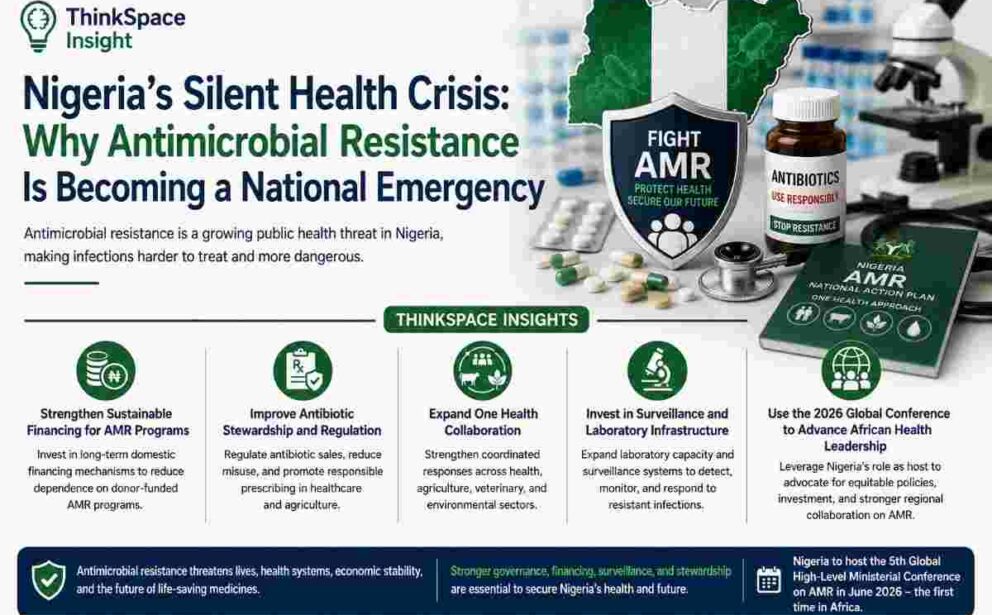
ThinkSpace Insights
1. Strengthen Sustainable Financing for AMR Programs
Nigeria must invest in long-term domestic financing mechanisms to reduce dependence on donor-funded antimicrobial resistance programs.
2. Improve Antibiotic Stewardship and Regulation
Stronger policies are needed to regulate antibiotic sales, reduce misuse, and promote responsible prescribing practices in both healthcare and agriculture.
3. Expand One Health Collaboration
Government agencies across health, agriculture, veterinary medicine, and environmental sectors should strengthen coordinated responses to antimicrobial resistance.
4. Invest in Surveillance and Laboratory Infrastructure
Expanding laboratory capacity and national surveillance systems is critical for detecting, monitoring, and responding to resistant infections effectively.
5. Use the 2026 Global Conference to Advance African Health Leadership
Nigeria can leverage its role as host of the 5th Global High-Level Ministerial Conference on AMR to advocate for equitable global health policies and stronger regional collaboration.
The review ultimately demonstrates that antimicrobial resistance represents one of the defining healthcare challenges of the modern era. Without stronger governance, financing, surveillance, and stewardship systems, resistant infections could reverse decades of medical progress.
For Nigeria, the fight against AMR is not simply about protecting antibiotics — it is about safeguarding public health, strengthening health systems, protecting economic stability, and securing the future effectiveness of life-saving medicines.
Read Abstract via https://ipsinterdisciplinaryjournal.com.ng/index.php/home/article/view/61