
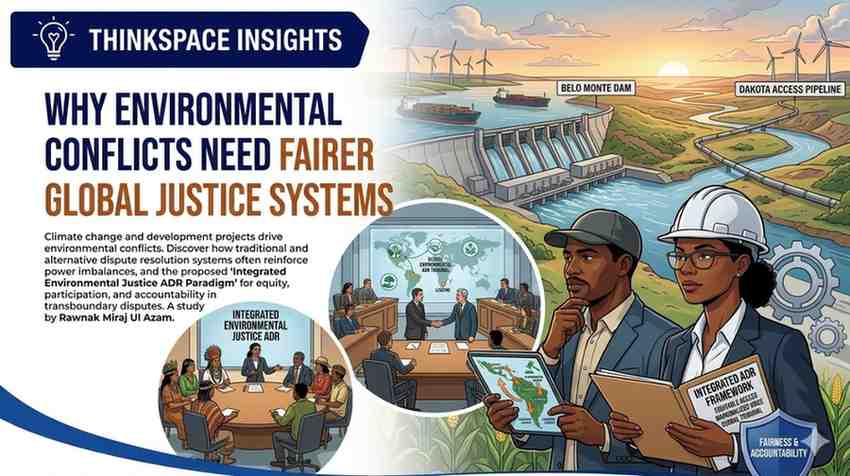
As climate change, infrastructure expansion, and resource extraction projects continue to grow worldwide, environmental conflicts are becoming increasingly common. From dams and pipelines to transboundary water systems and energy megaprojects, disputes over environmental harm often place governments, corporations, and local communities in direct opposition.
A recent study by Rawnak Miraj Ul Azam explores how Alternative Dispute Resolution (ADR) mechanisms can either help resolve these environmental conflicts fairly — or unintentionally reinforce inequality and exclusion.
Published in Conflict Resolution Quarterly, the paper examines the limitations of traditional legal systems and proposes a new framework called the “Integrated Environmental Justice ADR Paradigm” to promote equity, participation, and sustainable conflict resolution in transboundary environmental disputes.
The study argues that conventional litigation processes are often too expensive, rigid, and adversarial to effectively resolve complex environmental conflicts, particularly those involving vulnerable or marginalized communities.
While ADR mechanisms such as mediation, arbitration, and negotiated settlements are increasingly promoted as faster and more flexible alternatives, the research warns that these systems can still reproduce serious power imbalances when stronger political or corporate actors dominate negotiations.
Using a mixed-methods approach that combines legal analysis with comparative case studies, the study investigates how environmental justice is frequently undermined in large-scale infrastructure disputes.
The paper closely examines several internationally significant environmental conflicts, including:
The Lesotho Highlands Water Project
The Belo Monte Dam project in Brazil
The Dakota Access Pipeline in the United States
Through these cases, the study highlights what the author describes as “unattended voices” — communities whose concerns, identities, and environmental rights are marginalized or excluded from decision-making processes.
According to the research, Indigenous populations, rural communities, and economically disadvantaged groups often face significant disadvantages during environmental dispute resolution processes. Limited legal resources, unequal political influence, cultural barriers, and weak institutional protections can prevent meaningful participation.
The study argues that environmental governance cannot be considered truly just if affected communities are excluded from negotiations that directly shape their livelihoods, ecosystems, and futures.
To address these concerns, the paper introduces the concept of an “Integrated Environmental Justice ADR” framework designed to institutionalize fairness, reciprocity, and accountability in environmental conflict resolution.
One of the study’s most significant proposals is the establishment of a Global Environmental ADR Tribunal, which would provide more structured international oversight for transboundary environmental disputes.
The framework also recommends:
Mandatory Environmental Justice Impact Assessments
Cultural competency requirements for mediators and arbitrators
Stronger protections for marginalized communities
Greater transparency and accountability within ADR processes
The research emphasizes that environmental disputes are not only technical or legal problems — they are also social justice issues involving power, identity, displacement, and human rights.
Importantly, the paper highlights how global environmental governance must evolve to address increasingly interconnected crises involving climate change, infrastructure development, migration, and ecological sustainability.
The findings suggest that future environmental conflict resolution systems must move beyond efficiency alone and prioritize procedural fairness, inclusivity, and long-term sustainability.
ThinkSpace Insights
1. Environmental Justice Must Be Central to Conflict Resolution
Environmental disputes should prioritize fairness, inclusion, and protection for vulnerable communities rather than focusing solely on legal efficiency.
2. Marginalized Communities Need Stronger Representation
Indigenous groups, rural populations, and economically disadvantaged communities should have meaningful participation in environmental negotiations and governance processes.
3. Traditional Litigation Often Fails in Complex Environmental Conflicts
Rigid legal systems may be too slow, expensive, and adversarial to effectively resolve transboundary environmental disputes.
4. Global Environmental Governance Requires Institutional Reform
The proposed Global Environmental ADR Tribunal reflects growing recognition that international environmental conflicts need stronger cooperative governance systems.
5. Sustainable Development Depends on Inclusive Decision-Making
Infrastructure and environmental projects are more likely to achieve long-term stability when affected communities are genuinely included in decision-making processes.
The study ultimately demonstrates that environmental conflict resolution cannot succeed if justice, representation, and community participation remain secondary concerns.
As climate pressures and large-scale development projects continue to reshape societies worldwide, building fairer and more inclusive systems for resolving environmental disputes may become one of the defining governance challenges of the future.
Read Abstract via https://onlinelibrary.wiley.com/doi/10.1002/crq.70016