
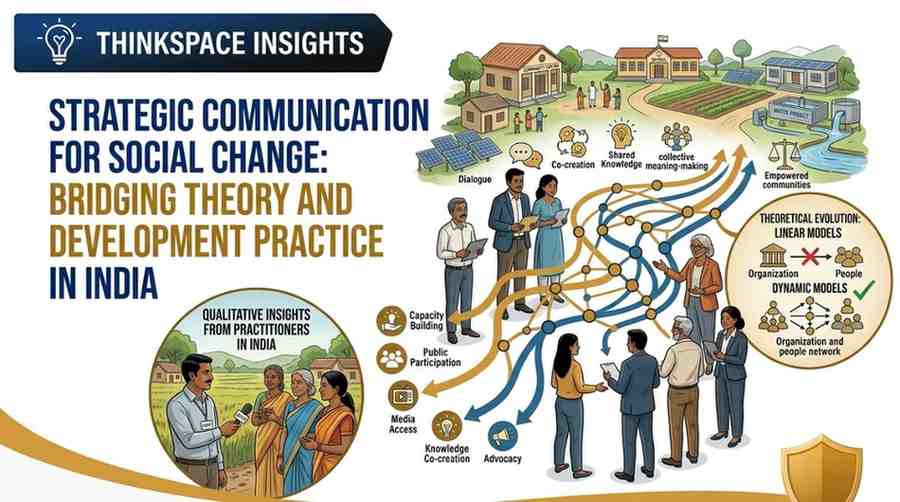
In the global landscape of development and social change, strategic communication (SC) remains an absolute imperative for practitioners. However, despite its practical importance, SC is frequently under-researched within the specific context of development. Historically, the application of SC has been narrowly confined to organizational-level planning aimed at driving individual behavioral changes. This restricted approach often fails to capture the true richness of SC scholarship and overlooks the complex power dynamics, varying cultural contexts, and necessary public participation that actually drive structural social change.
The academic fields of SC and Communication for Development and Social Change (CDSC) have, however, witnessed significant theoretical evolution over the past two decades. Modern scholarship has definitively moved away from viewing communication as a linear, top-down process driven solely by an organization. Instead, contemporary theories embrace the discursive and dynamic nature of communication. There is now a much greater focus on collective meaning-making, the co-creation of knowledge among societal actors, and the sociopolitical aspects of community empowerment, social justice, and communication rights.
A compelling study by researcher Bhupesh Joshi explores exactly how these advanced theoretical concepts can be translated back into the daily practices of development institutions. To bridge the gap between academic theory and on-the-ground execution, Joshi conducted primary qualitative research investigating four major development projects in India. By interviewing 20 active development and communication practitioners, the study captures a realistic picture of the communication strategies currently prevalent in the field.
Ultimately, the paper serves as a vital translational tool. By synthesizing these qualitative findings, Joshi extracts highly actionable insights, outlining five specific areas that organizations must prioritize when engaging in strategic communication for development projects. This research provides a much-needed framework for ensuring that the comprehensive, inclusive advances made in communication theory are actually utilized to drive meaningful social change in practice.
ThinkSpace Insights
- Strategic communication is historically underutilized in development, often reduced to basic organizational messaging rather than being deployed as a complex tool for societal transformation.
- Modern communication theory rejects linear models, shifting the focus toward dynamic, multi-directional processes that emphasize co-creation and collective meaning-making among stakeholders.
- Effective development communication must prioritize sociopolitical realities, embedding concepts like community agency, social justice, and communication rights directly into program planning.
- Bridging the gap between advanced theory and daily practice is essential to ensure development institutions are not relying on outdated, top-down messaging strategies.
- Qualitative data gathered directly from practitioners in India provides a crucial, real-world baseline for understanding how strategic communication is currently functioning in the Global South.
- Successfully deploying SC in development requires targeted structural adjustments, specifically focusing on the five key operational areas identified in the study.
Access Full Article